Teaching skepticism; fast Australian publishers; AI fiction tells: Newsletter 24 June 2026
Newsletter 157. Calculators give wrong answers all the time, just like AI — there’s a lesson in that. Plus, creating a media empire from your IP, AI steals your voice, three people to follow, and three books to read.
Is the answer right?
We’re focused on getting answers. We should be more focused on whether those answers are right.
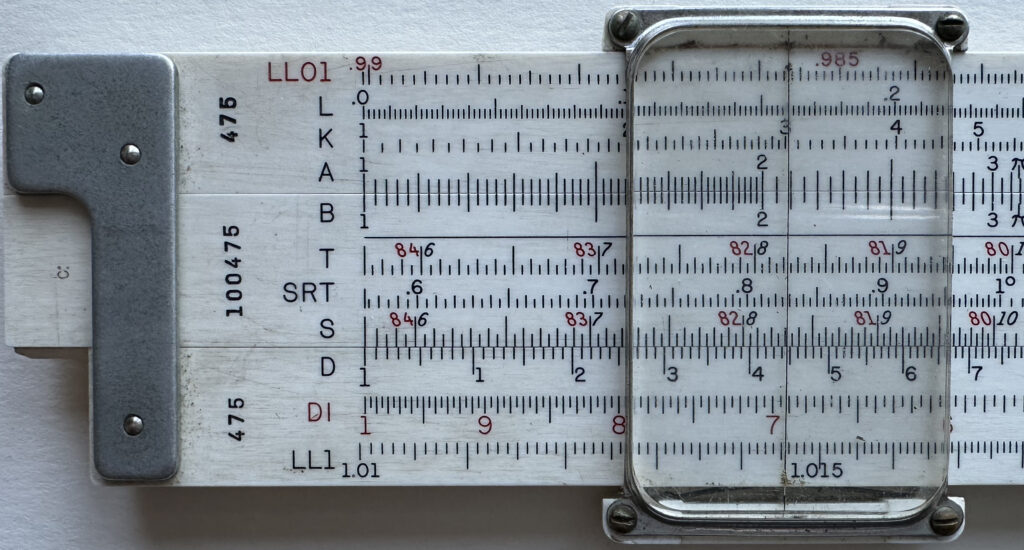
My father was a chemistry professor during the 1970s when for the first time, nearly every student could afford a calculator. Before that, students used a slide rule, a handheld mechanical device (shown above).
Slide rules give you an answer, but not the order of magnitude. If the slide rule says the answer for the amount of water created in a reaction is 5.07, that might be 0.507 grams, 5.07 grams, or 5,070 grams (5.07 kilograms). Only one of those answers made sense in the context of the problem. If you’re operating with fractions of a gram of components, then the right answer is probably closer to half a gram than 5 kilograms.
Unlike a slide rule, a calculator gives a full answer. But when more students used them, my dad noticed that more students were giving nonsensical answers — like a countertop reaction generating 5,070 kilograms of copper (5 metric tons). The machine coughed up the answer; the student wrote it down without thinking. But a moment’s thought should have told the student that 5 tons of copper is absurd — a clue that they’d made a mistake somewhere.
Now it’s not just numbers. You can get an answer for any question. Why did Russia invade Ukraine? What is the best way to drive traffic to a web site? Are vaccines safe? What steps should you take before painting the bottom of a pool of water?
Like a calculator, a web search or an LLM query generates an answer. Like a calculator, it doesn’t have guardrails: there’s usually some output shown. The key question for 2026 and beyond is no longer “What is the answer?” It’s “Is the answer right?”
We need to train everyone — but especially young people — to understand the context of the answers they are getting. Where did the answer come from? Could it be wrong? If so, why? Could it be a half-truth? What’s missing? What else do you know that the answer fits into? If it is true, what else does it imply, and do those implications make sense? What other answers are possible? How would you tell which answer is correct?
My dad never taught his students to use a slide rule; they showed up in college already familiar with one. But even though calculators were easier to use, he needed to teach them how to use one: how to think about the answers the calculator was suggesting, whether they fit the problem, and how the student could check them.
Every teacher at every level must now teach the same level of contextual awareness for AI answers. Prohibiting your students from using AI tools is counterproductive, just as it would have been for my dad to stop students from using calculators; since those tools are available in the real world, students should be using them. Instead, teach your students to be skeptical. Teach your students to ask why the answer is true and where it comes from. Teach them to be smart about the world so they have context for what they are reading. “That’s what Google or ChatGPT said” is no justification for an answer, any more than “That’s what the calculator spit out” would be in a chemistry class.
And the rest of us need the same skills. Doubt Claude. Query ChatGPT. Probe Gemini. Poke at Grok. An instant answer is instantly suspect.
The key mindset of those seeking knowledge now is no longer “What is the answer?” Our watchword must always now be, “Is the answer right?”
News for writers and others who think
AI generated fiction is lame, and now we can measure it. According to a quantitative study by researchers from the University of Maryland and Google, “AI stories over-explain themes and favor tidy, single-track plots while human stories frame protagonist’s choices as more morally ambiguous and have increased temporal complexity (e.g., flashbacks, nonlinear structure).” Such clues are even more dispositive than so-called “AI tropes” like “It’s not just x, it’s y.”
Granta magazine will no longer publish an anthology of its short-story winners because it can’t prove they weren’t generated by AI. (Maybe they need to hire the researchers from the first item.)
Should you be focused on turning your book content into an empire. In Elle, read about Kennedy Ryan, who has started to leverage her novel into the center of an entertainment production machine.
Authors always complain that publishers go way too slow. Except, apparently in Australia, where they’re complaining that publishers go too fast and put books out without appropriate quality control.
On Jane Friedman’s blog, Tawny Lara argues that depending on AI too much robs you of the chance to find your voice as an author.
Three people to follow
Wendy Keller , literary agent and speakers bureau owner
Ted Olczak , publisher of Printed Word Reviews
Jessica Weber Metzenroth, PhD , exploring ways to keep corporate writing effective and slop-free
Three books to read
Quantum Bullsh*t: How to Ruin Your Life with Advice from Quantum Physics by Chris Ferrie (Sourcebooks, 2023). An actual quantum physicist dismantles the ways that hucksters use quantum theory to justify philosophical quackery.
A Pox on Fools: The True Believers, Grifters, and Cynics Who Convinced Us to Reject Vaccines by Thomas Levenson (Random House, 2026). Debunking antivax pseudoscience.
Empire of Ink: The Printers, Rogues, and Radicals Who Invented the American Newspaper by Alex Wright (Basic Books, 2026). America’s first media revolution: the rise of the popular newspaper.
It’s interesting that the slide ruler v calculator issue WAS the same problem–unit or dimensional analysis, which IS taught in science and engineering schools. (And no, the answer was not obvious.) I am not sure if it was in that class or another that we learned when and how to estimate and when to allocate resources to precision.
We have learned that in order to require folks to use tools, we have to teach them how they work and when which tool is appropriate. And in the real world, we have to teach those basics to everyone when they join organizations and switch facilities/functions. The skills can be transferable, but must be verified and supplemented with location- and equipment-specific information (and any organizational slants). This goes to basic tools like hammers (of which there are dozens) and basic concepts (such as all fasteners require torquing and what they means and how does one do that). (And no, these are not obvious nor common sense.)
And folks need to be taught critical thinking skills, which includes accounting for mistakes, safety factors, Chesterton’s Fence, Lake Wobegon, Donald Rumsfeld, how to learn, feedback, and humility.
Engineering is mostly using information from sources and spitting out answers. It is not trivial. Knowing which information and where to get it is a skill. Like reading/composition teachers will tell you that there are only seven stories, I remember my statics/dynamics professors telling us that there were only something like seven problems and the key was determining which of those you were solving and then using the canned information.
Fun trivia: scientific calculators cost a few hundred dollars at the beginning of the 1970s (I remember traveling far in the DC area then with my Dad to get his expensive first) to about $150 by the end of the 70s (my HP 15C, with RPN, in 1984 when I started engineering skool was about that and still works today and thanks to RPN is better, faster, and cooler than a Cray or any AI).