Moral panic over AI at the Nebula Awards
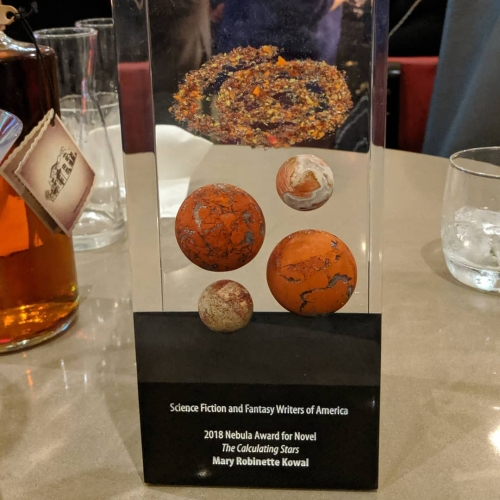
Should AI-generated or AI-aided writing be eligible for writing awards?
This is the challenge that SFWA — the Science Fiction and Fantasy Writers Association — is navigating with its annual awards, the Nebula Awards. Briefly, there are two major sets of awards in the science fiction and fantasy community. The Hugo Awards are voted on by fans. The Nebula Awards are voted on by writers, much in the same way as the Emmys or Oscars are voted on by professionals in their respective professions.
As I vividly learned in our survey on AI and the Writing Profession, fiction writers are even more polarized than practical nonfiction writers in their attitudes about AI. Fiction writers who don’t use AI are nearly unanimous in their outrage over writing that uses it.
Of course, when it comes to science fiction writers, there’s the added factor that the writers themselves are often immersed in writing about the impact of technology, especially in dystopian scenarios. So it was eminently predictable that that controversy would erupt among science fiction and fantasy writers on how to recognize — or ban — AI-aided writing.
SFWA created an AI policy, then immediately backtracked
On December 19, SFWA posted this statement about AI and its use in Nebula-nominated works:
At SFWA, we believe in our creators, and we want the Nebula Awards to recognize work that is human-created and expansive.
We want to reinforce industry standards while also encouraging the industry to do better: from crediting authors to valuing their work, to promoting transparency and open dialogue among creators.
Our Complete Nebula Awards® Rules take this approach to heart. The rules state:
- Works that are wholly written using generative large language model (LLM) tools are not eligible.
- Works that used LLMs at any point during the writing process must disclose this upon acceptance of the nomination, and the nature of the technology’s use will be made clear to voters on the final ballot.
To repeat, works that are wholly written using generative large language model (LLM) tools are not eligible. The Nebula Awards honor writers and the work they create, not the LLMs they employ.
When finalists are contacted, before they appear on the ballot, they will be asked to disclose any LLMs they used in the production of their work. The voters can then decide if they would like to vote for these works.
As of now, the industry standard overwhelmingly favors human-created work, from submissions guidelines to awards lists. As your SFWA President, I hope we continue to move in a direction that honors, supports, compensates, and celebrates the humans behind the great stories and poems we have the honor of reading, playing, and watching.
This seemed pretty reasonable — clearly machine-written prose shouldn’t be eligible for recognition. Regarding “Using LLMs at any point during the writing process,” that’s far less straightforward, given how thoroughly LLMs and AI have pervaded ordinary tools like Google Search, Microsoft Word, and Grammarly.
But that wasn’t sufficient for the AI alarmists within the SFWA community. So three days later, after objections from members, SFWA responded with revised rules:
To be clear, SFWA does not support the use of LLM generative models in the production of creative work.
The Nebula Award Rules did not reflect our current policy and deeply held beliefs and values, and they were amended to reflect that.
With further input, today, we made an important change to the Nebula Awards Rules in two board votes that we would like to share with you:
Previous Text:
“Works that are wholly written using generative large language model (LLM) tools are not eligible.”
New Text:
“Works that are written, either wholly or partially, by generative large language model (LLM) tools are not eligible.”
-and-
Previous Text:
“Works that used LLMs at any point during the writing process must disclose this upon acceptance of the nomination, and the nature of the technology’s use will be made clear to voters on the final ballot”
New Text:
“Works that used LLMs at any point during the writing process must disclose this upon acceptance of the nomination, and those works will be disqualified.”
I see many problems with this amended statement. Now writers who use Grammarly, which is built on AI, or Perplexity for web search, are, officially, ineligible for consideration. Consider these hypotheticals:
- A writer uses conversations with ChatGPT to determine if any other writers have written on the theme they have written on, in an effort to avoid inadvertent plagiarism and focus on their most original ideas.
- A writer notices that they have a mannerism — say, ending scenes with statements similar to, “But that was not to be.” So they ask Claude to read their draft and find that and other mannerisms and flag them so they can possibly choose to remove or change them.
- A writer uses no AI in creation of their text. They send it to an editor for review, but the editor uses AI tools to help them make suggestions to improve the text, and the writer takes some of those suggestions.
- A writer is wondering when a particular technology was invented, for a historical passage in what they are writing (say, regarding the World Wide Web or the microprocessor). The writer does a web search on Google, and Google offers up an AI summary. The writer uses the AI summary to find links to historical pages and then uses the facts on those historical pages to inform the narrative.
This is far from a complete list. AI and LLMs are pervasive. Using them to write creative prose and then pursuing award nominations for that text is wrong. But a purist attitude banning all LLM use is completely impractical.
SFWA is going to regret this. It’s pretty shortsighted for an organization full of visionaries with great imaginations. I don’t think this is the last we’ve heard on this topic, because the distinction between “creative” writing and machine-generated slop is going to become increasingly difficult to discern.
I didn’t appreciate the many levels of gray between “AI-assisted” and “AI-free.” Thanks for opening my eyes.
In the 1950s, when someone commented that 90 percent of science fiction writing was crap, science fiction writer Theodore Sturgeon replied that 90 percent of _everything_ is crap. This became known as Sturgeon’s Revelation. Thanks to LLMs and the people who use them, that figure is now generous.
The main problem I see is that most of the apparent “justifiable” use cases for AI in writing do not need AI at all. It is like killing a fly with a cannon ball.
You want to know if other people have written your idea? Use a librarian or a good web search (no AI needed). You want to detect a mannerism? A simple in-text search would do. And do not get me started on the supposed “improvements” to somebody’s writing through AI suggestions.
If you search Google, Google presents an AI summary at the top of the page, before the search results, along with links to the sources it uses.
I completely agree. Is authenticity an inverse function of technology? If so, should we revert to chiseling stone tablets?