A snapshot of my happy and balanced editorial business in 2025
It always pays to look back at your work for the year and see what you’ve learned, how you’ve grown, and what you like doing most. As a freelancer who carefully tracks my business, I’m in an ideal position to do a retrospective. I hope you can learn a bit from my own reflections on my year.
My business in 2025 brought in about the same as I made in 2024, and a little less than I made in 2023. But I optimize my work, not for total revenue, but for a balance of cash flow, happiness, and fulfillment. I try to balance generating income from a variety of tasks from a variety of clients without too many overworked or lean periods.
As you’ll see from the data I share below, I think I accomplished this pretty well. I had 16 clients in 2025 and sent 65 invoices (53 for compensated work, 12 for expenses). That may not sound like much, but it still generates well in excess of six figures of income, because I’m pretty pricey. The average invoice was $3,000, but I did send one invoice for $20,000 and one for just $350.
The work and the clients were varied
Here’s a chart of how I made my income in 2025.
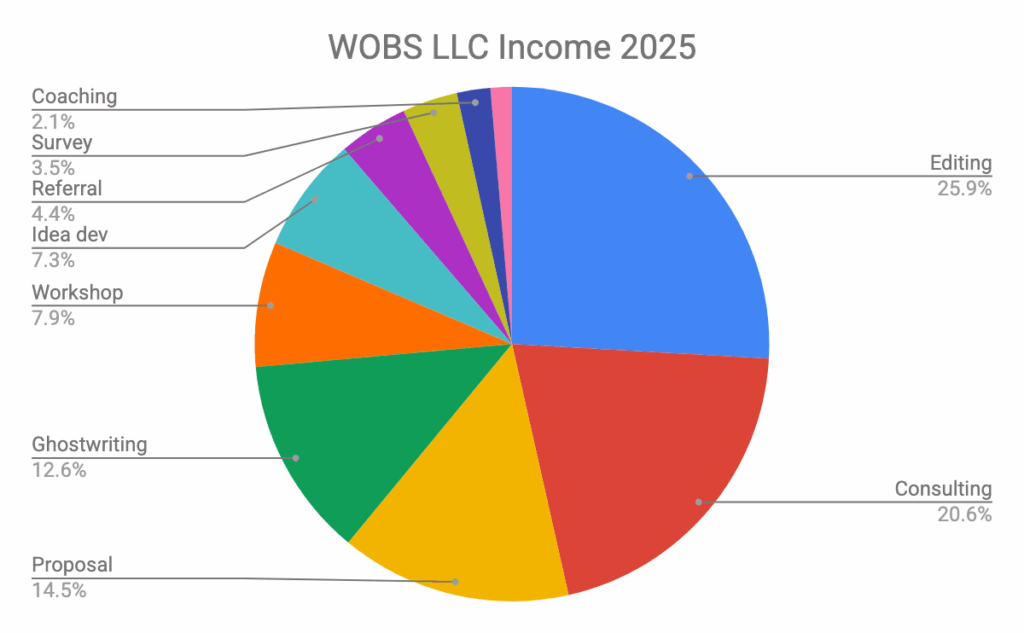
For the last few years, ghostwriting has been about half of income, even though I only do one ghostwriting project at a time. Ghostwriting revenue was less in 2025 because one project was winding down (no longer in the ghostwriting phase, so accounted for as consulting) and one was ramping up (in the proposal stage). As you can see, I made 26% of my income from editing book manuscripts.
A few other items here are worth noting. The 8% for “workshop” includes two corporate workshops that now incorporate AI coaching, not just writing counseling. The 7% for idea development is the first stage of my work with authors. The 4% labelled “referral” includes bounties for referring authors to agencies and hybrid publishers; this minor amount of money doesn’t distort my recommendations.
The 4% labelled “survey” refers to the work I did on the “AI and the Writing Profession” survey for Gotham Ghostwriters. Because we were unable to get a media sponsor, I faced a decision: Do the work for less than half of what I’d normally get paid, or pass. I chose to do the work for lower compensation, because I wanted to build reputation as an expert on AI and writing. That worked out well for me.
The other element of balance is making sure I’m not too dependent on any one client. My two largest clients each generated about 22% of my income this year. I’d hate to lose those clients, but I could certainly withstand the loss of income if necessary — and that makes it far easier to make sure no client can put me in an untenable position.
My clients come from a variety of sources
One client came to me because of my book Build a Better Business Book; all the rest were from word of mouth. This is why I work so hard to maintain a good reputation with clients and fellow authors; they’re the number one source of my business. The only client who fired me in 2025 was the one that found me through the book. On the other hand, one of my largest clients gave me a healthy unsolicited bonus. For the most part, the clients are happy.
A healthy 30% of my business came through the agency Gotham Ghostwriters, a relationship I highly value. Clients referred by Gotham pay them a fee on top of my prices, but they are vetted and well matched to my capabilities, which tends to generate a successful engagement.
An additional 8% of my income came from referrals from publishers. And 8% (the workshops) came from corporate clients. The remaining 54% came from individual authors.
This mix is ideal from my perspective. I have close and supportive relationships with individuals and they tend to pay quickly, but the publisher and agency relationships tend to be larger contracts.
My cash flow is balanced and my clients pay quickly
An ideal freelance income stream avoids extended time periods that are either short on revenue or overcrowded with work. That’s probably the hardest thing to manage as a freelancer.
When revenue peters out, I focus more on marketing myself and become a little more open-minded in which jobs I accept.
Even when I’m busy, I hate turning people away. I also hate telling people that their job has to wait behind others. So when I can’t complete work quickly or need to work weekends, that’s a signal that I need to increase prices and become more selective.
Here’s how my billing dates lined up with the months in 2025:
| Month in 2025 | % of 2025 billings |
| January | 14% |
| February | 2% |
| March | 7% |
| April | 8% |
| May | 11% |
| June | 11% |
| July | 6% |
| August | 2% |
| September | 11% |
| October | 13% |
| November | 6% |
| December | 10% |
If things were spread evenly, I’d bill 8% of my total year’s income in each month. As you can see, I had lean months in February and August. But I had great months in January and October which allowed me to weather those leaner months. Quarter-to-quarter my revenue was fairly even; my richest quarter was Q2 (30%) and my leanest was Q3 (19%).
The other things that drives freelancers crazy is delayed payments from clients. Working with fast-paying individuals helps me avoid that problem. A healthy 53% of my invoices and 60% of my billings were paid within seven days. Only 4% of my invoices and 2% of my billings took more than 60 days to collect. Some large corporations will delay payment for 60 days or more and then offer to accelerate their payment if you fork over a fee of 2% or more. My goal is never to be desperate enough to need to do that.
This is also one of the advantages of working with agencies. When it’s necessary to dun a client because they’re late paying, the agency takes care of that for you. That means I only talk to clients about work, not payments, which is far preferable.
Weighted by amount billed, it takes an average of 12 days from when I bill to when I get paid. I’m very happy with that.
Balancing familiar business and new ideas
My business evolves. That keeps it from being boring. My survey work was new in 2025. I learned that I love doing the surveys and hope to do more.
The corporate workshops with AI coaching were also new in 2025. I won’t be doing more of them. They were interesting to prepare, but I’m unwilling to put in the effort that would be required to represent myself out as an expert on corporate AI use, a field crowded with countless other consultants.
In 2026, I’ll be concentrating on helping individual authors with idea development, proposals, ghostwriting, editing, and coaching.
I also have an exciting new revenue-generating product coming in 2026. You’ll hear more about it shortly. I may be in my sixties, but I’m still learning new content and techniques and trying out new ideas.
I could not imagine a more interesting and enjoyable way to make a living.