Don’t use AI for the most human parts of writing
It’s natural to use technology tools to make writing more efficient. Nobody is suggesting going back to typewriters and Wite-Out or looking up spellings in a paper dictionary. But now that we have AI, it’s tempting to outsource large amounts of the work in nonfiction writing to AI tools.
This is a mistake for several reasons:
- It weakens writing skills.
- It creates soulless text that’s boring to read.
- It potentially introduces errors.
- It may limit the copyright protections of the resulting text output (AI-generated text is not protected by copyright).
- It removes one of the most valuable parts of the writing process: discovering new truths through the process of writing.
Keep doing the most meaningful parts of writing yourself
The key is to concentrate your human effort on the parts of writing that are most meaningful, both to the reader and to the writer. You should do the ideation, title, fat outline, and completed draft yourself before involving AI tools. This improves the human qualities of what you create and makes the creation yours, not a machine’s.
So here’s my detailed set of suggestions on when and how to use AI, and when not to.
- Initial ideation. Write a statement about your ideas yourself. Then optionally use AI to improve it.
- Title and headings. Take a first shot at this on your own. But AI is a great tool for suggesting alternatives once the piece is written. In my recent survey of more than 1,400 writers, this was the most common use for AI; 72% of writing professionals used it at least sometimes.
- Research. AI tools like Perplexity make this far more efficient.
- Fat outline. Create a fat outline before writing based on your own ideas. While it’s also useful to load all your source material into an AI tool and get it to suggest and outline, you should compare its suggestions to what you came up with on your own. Don’t just blindly follow its suggestions.
- First draft. This is typically a collaborative effort, with some drafted by the writer and other parts created with suggestions from the AI tool.
- Revisions. AI can be a great help here, as it often can make useful suggestions based on reading what you’ve drafted. As with any reviewer, it’s up to you to decide which AI suggestions are improvements and which aren’t.
- Complete draft. It’s worthwhile to rewrite your final draft from start to finish, adding human touches and removing sections that include AI tells and other boring AI-generated elements. The complete draft should be identifiably yours, based on your own word choices, sense of style, and sense of humor.
- Final draft. AI can help in the final draft with grammar checking, consistency, managing citations and footnotes, and other less creative tasks.
Don’t outsource your soul
Writing is fundamentally a communication from one human to others. If a machine is doing the drafting, that gets lost.
Writing is also a joyful experience. Don’t give up on it.
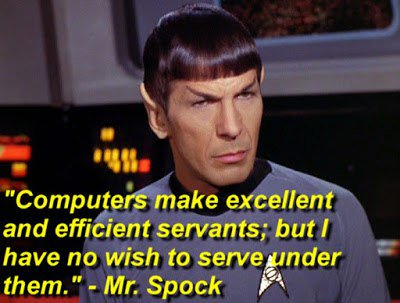
As Mr. Spock said in the classic Star Trek episode “The Ultimate Computer,” “Computers make excellent and efficient servants, but I have no wish to serve under them.”
Why avoid using AI excesssively? “1. It weakens writing skills.” What you don’t use, you lose.
I take this approach and make sure my chatbot instructions make it clear. I can’t imagine outsourcing the fun parts!
I also not only tell a publisher when I’ve used AI tools for writing and image generation, but also relate how I use this approach and what that means for the process used to develop piece they are reviewing.