Did Nvidia CEO Jensen Huang use AI to write his apology?
Jensen Huang, CEO of the world’s second-most valuable company, Nvidia, had an affair with a woman named Huang Le (no relation). According to the New York Times, US intelligence identified Huang Le as a Chinese spy. This is significant because China wants access to the AI-powering chips that Nvidia makes, but US policy restricts that access.
Jensen Huang published an apology. I’ll analyze it, both from my own perspective as a writing expert, and by reviewing what AI tools have to say about it.
The text of Jensen Huang’s apology
Here’s what Huang wrote to the employees of Nvidia:
I owe my family and all of you an apology.
I was unfaithful to my wife. My actions hurt her and our children. There is no excuse for what I did. I am deeply sorry.
Throughout my life, my family has given me love and support. They deserve my honesty and loyalty. Instead, I let them down and damaged the life we built together. I take full responsibility for what I did and the hurt I caused, and I accept the criticism that comes with it.
To my wife and family: I love you. I know an apology cannot undo what I have done. I hope our family will heal and that, over time, I can earn back your trust.
To my colleagues at NVIDIA, including those I have worked alongside for decades, and to our board, partners, and shareholders around the world: you deserve better from me. Leading NVIDIA is the privilege of my life. My responsibility is to serve you and be worthy of your trust. I have fallen short of that responsibility. I am fully committed to NVIDIA and will work to earn back your confidence.
Regarding the national security concerns raised in news reports, NVIDIA’s Board of Directors has initiated an independent investigation. I support the investigation and will cooperate fully. I love our country and our company. I am committed to protecting NVIDIA and supporting America’s national security. I am proud and grateful to be an American.
My family bears no responsibility for my choices. I do. Please give them privacy.
Jensen
Is this apology appropriate?
This apology contains some of the elements that are appropriate in a sincere apology, but not all.
- It states the offense clearly. Huang had an affair and he admits it.
- It identifies the people hurt. He apologizes to his family and to the employees, partners, and shareholders of Nvidia. But all he says about Nvidia is that he was dishonest. He doesn’t explain why his dishonesty is a problem.
- He is unclear about how his affair may have contributed to national security problems. He does not reveal any of what he discussed with Huang Le. This is not surprising, given that such discussions are probably subject to disciplinary action, if not prosecution. All he says is that he will cooperate with his company’s investigation.
- He makes no statement about what he will do differently. For example, he could give his board of directors more governance power. But of course, CEOs never give up power voluntarily.
Jensen Huang deserves credit for coming clean and writing a statement this is brief and includes no excuses for his behavior. It’s probably the best he could do under the circumstances, but of course, like all such statements, it falls short.
Did Jensen Huang write this statement, or did AI?
In situations such as this, CEOs typically work on the statement with their senior PR advisors. But given that Nvidia is the world’s most valuable AI company, it’s fair to ask: did he use AI to write this statement?
I ran the statement through Pangram, the best available AI detector. Here’s what it said:
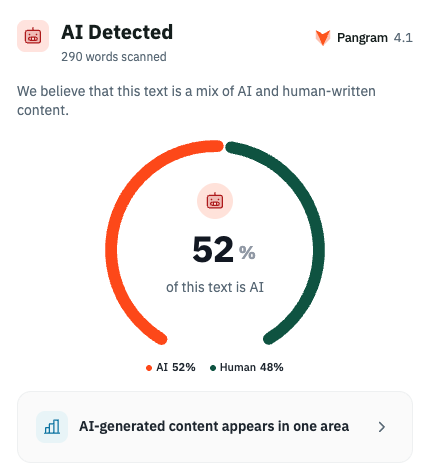
Pangram reports that the statement is 50% AI-generated. Pangram is least dependable on short passages like this one, so don’t take this rating as gospel. Pangram identifies which portions of the statement read as if they were written by AI. This is the suspicious part:
Throughout my life, my family has given me love and support. They deserve my honesty and loyalty. Instead, I let them down and damaged the life we built together. I take full responsibility for what I did and the hurt I caused, and I accept the criticism that comes with it. To my wife and family: I love you. I know an apology cannot undo what I have done. I hope our family will heal and that, over time, I can earn back your trust. To my colleagues at NVIDIA, including those I have worked alongside for decades, and to our board, partners, and shareholders around the world: you deserve better from me. Leading NVIDIA is the privilege of my life. My responsibility is to serve you and be worthy of your trust. I have fallen short of that responsibility. I am fully committed to NVIDIA and will work to earn back your confidence.
This may or may not have been written by AI, but it is written very much like hundreds of similar apologies. This could reflect AI authorship, or it could just reflect that there are only so many types of sentences that you can include in an apology. These are the sentences that Pangram finds the most suspicious:
- “Instead, I let them down and damaged the life we built together. I take full responsibility for what I did and the hurt I caused, and I accept the criticism that comes with it.”
- “I know an apology cannot undo what I have done. I hope our family will heal and that, over time, I can earn back your trust.”
- “My responsibility is to serve you and be worthy of your trust. I have fallen short of that responsibility.”
Those are indeed generic sentences that could appear in any such apology. While originality is not the most important criterion for an appropriate public apology, Huang’s words are just what you would expect to read in any other apology. If I were his PR counsel, I’d probably try to create something a little more human and original, but of course, generic, well-word clichés have less risk — and risk is important in this context.
How does AI compare this to other similar apologies?
I asked ChatGPT to compare this apology to other famous apologies. (Normally, I wouldn’t trust it with such a task, but given what Huang’s company does, I think it’s only fair to let AI have a go at it.) It compared the apology to other prominent people who had affairs, including Tiger Woods, Bill Clinton, David Letterman, and Mark Sanford (a governor).
Here’s some of its critique:
What makes Huang’s apology distinctive
Huang’s full statement, published by Nvidia is relatively brief, about 300 words. It contains several important elements.
1. He states the offense plainly. His second paragraph begins, “I was unfaithful to my wife.” There’s no euphemism about an inappropriate relationship, a lapse in judgment, or a personal mistake.
2. He explicitly rejects excuses. He writes, “There is no excuse for what I did.” He doesn’t blame stress, loneliness, his marriage, or the pressures of his job.
3. He identifies the people he harmed. He apologizes separately to his wife and children, his colleagues, Nvidia’s board, its partners, and shareholders.
4. He accepts responsibility without demanding forgiveness. He recognizes that an apology cannot undo the damage and that restoring trust will take time.
5. He separates personal responsibility from family privacy. His closing request for privacy emphasizes that his family bears no responsibility for his behavior.
6. He commits to cooperating with an investigation. This addresses the corporate and national security dimensions of the scandal, although it doesn’t explain his conduct in those areas.
In my opinion, this is wrong. The statements are true, but they do not make his apology distinctive. They are just what you would expect.
Here’s how ChatGPT compares Huang to the other famous apologizers:
How Huang compares with four famous apologies
Tiger Woods (2010), multiple extramarital affairs
Woods was similarly explicit, admitting that he had cheated and accepting sole responsibility. He also emphasized that restoring his wife’s trust required changed behavior over time.
Difference: Woods offered a psychological explanation, describing his sense of entitlement, and discussed treatment. Huang offers no explanation of why he acted as he did.
Bill Clinton (1998), Monica Lewinsky scandal
Clinton accepted responsibility but described the relationship as inappropriate and a lapse in judgment.
Difference: Clinton combined his admission with legal defenses and criticism of the investigation. Huang avoids attacking investigators or questioning their motives. However, both attempt to distinguish personal wrongdoing from their ability to continue leading.
David Letterman (2009), sexual relationships with staff members
Letterman apologized to his wife and employees, acknowledging the damage his behavior caused.
Difference: Letterman used humor and conversational language, consistent with his television persona. Huang’s apology is formal, restrained, and corporate. Both acknowledge that repairing their marriages is an ongoing task.
Mark Sanford (2009), affair during his governorship
Sanford admitted infidelity, apologized to his wife and children, and requested privacy for them.
Difference: Sanford gave a lengthy, emotional, sometimes rambling explanation of how the relationship developed. Huang supplies virtually no narrative. Sanford also relinquished a political leadership position; Huang explicitly commits to continuing as CEO.
These comparisons are interesting. They reveal what Huang left out. There is no psychological explanation, no legal defense, no humor, and no narrative. I don’t think Huang’s apology would be better with such elements included, but this comparison shows how bloodless and unemotional his statement is.
ChatGPT concludes with this:
As an exercise in apology writing, Huang’s statement is stronger than most public apologies for infidelity. It is concise, specific about the wrongdoing he admits, and largely free of defensiveness.
But an effective apology is not necessarily a complete accounting. Huang has written a strong apology for betraying his wife and a much less informative response to the corporate and national security questions.
The most revealing contrast is with Tiger Woods. Woods attempted to explain the personal failures that produced his behavior. Huang avoids that entirely. His statement is designed to accept moral responsibility without getting ahead of an investigation.
That makes Huang’s apology a particularly interesting example of crisis communication: he takes responsibility for what he admits doing, while carefully avoiding conclusions about what those actions may have caused.
This critique is disappointing. It is shallow and lacks analytical insight. It leaves out the emotions: not only Huang’s, but the emotional reaction of the public to the fallibility of a corporate leader who was previously considered heroic and admirable.
ChatGPT writes like a machine. That’s no surprise.
But Huang does, too. That’s disappointing.