Documents enable decisions; publishing’s AI ambivalence; tech’s Trump regrets: Newsletter 11 November 2026
Newsletter 176. The acid test for every document you write. Plus, how writers can justify getting paid, forcing AI scrapers to include links, big tech’s political miscalculation, three people to follow, and three books to read.
The only reason to write at work: enabling decisions
Amid all the discussion about whether workers should use AI at work, we’ve lost track of the most important thing: the purpose of writing.
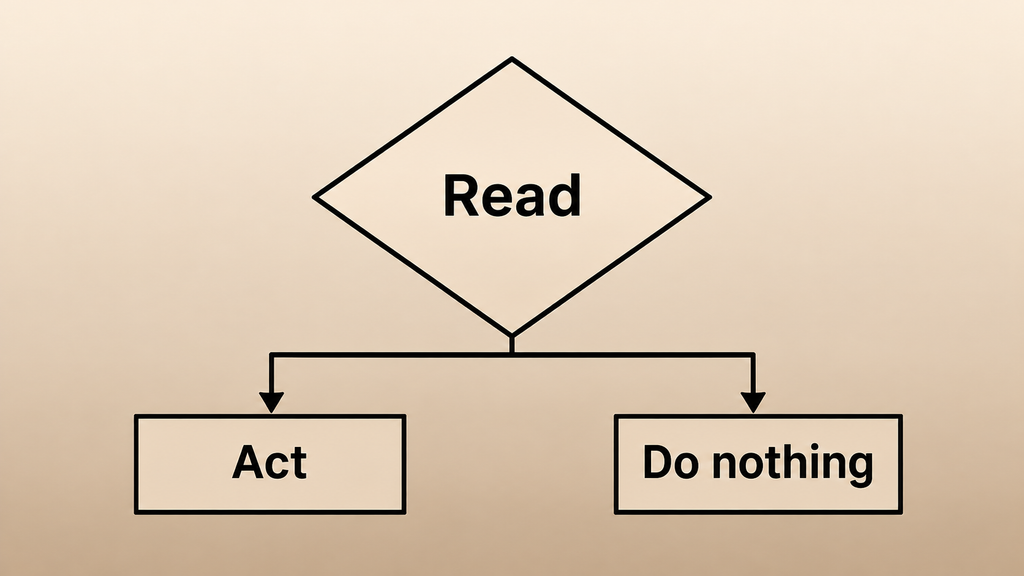
The only reason to write and share anything in an organization is to enable readers to make a decision.
Think about it. If you read an email, a status report, a how-to document, a strategy memo, what is your reaction?
If the written material enables you to think differently about something that matters, it is worthwhile.
If the written material does not, it is useless. It’s a waste of your time. Not only are you likely to resent the wasted time, you’re likely to resent whoever wrote it and sent it to you.
And why do you need to think differently? To make a decision.
There are all sorts of decisions. Should you, an executive, agree to launch a new product? What should you, a manager, do to support a new corporate strategy? What should you, a member of a department, do differently as you interact with customers? What should you, a worker, do to comply with a new HR policy? These are all decisions that documents, emails, or other written communications can help you make.
If you accept my definition of the purpose of documents at work, then you have a job to do every time you create one. You must:
- Decide who the audience is — the group you want to make decisions. Sending it to anyone else is wasteful. The document should say up front who it is aimed for.
- Be clear about what decision or decisions you are enabling and describe them in the first few sentences. “This document will help us decide whether to launch product X,” for example, or “This document will reveal the results of our customer survey, which will enable us to change our products and processes to better serve those customers.” When you’ve thought about what decisions the document enables, you can better decide what to include in it and how to structure it.
- Provide evidence. No one makes a decision in a vacuum. Workers don’t happily comply with corporate directives that lack justifications. The evidence you include should be all and only what the audience needs to make the decision.
- Describe the action you expect. If you cannot determine what you hope to happen after people read what you wrote, why did you bother writing it? For example, “If you accept this evidence and justification, we should assign resources to enable us to launch the product in Q2 of next year.” Or “Please follow the guidelines in this document so we can accurately compute sales bonuses for the quarter.”
- Almost nothing else. More people will read the document if it is short and well-argued. If it includes only the evidence and justification for the decisions, it will be effective. If it rambles and includes irrelevant information, it won’t.
What does this mean for writing without slop?
AI writing is well-structured and logical. If you tell an AI tool that you want your document to enable audience X to make decision Y, it will organize the document around that goal. It will also help find and assemble evidence (although you need to check that evidence). That’s a useful way to enforce the discipline of making sure your document succinctly enables a decision.
AI writing is also boring and inhuman. Writing with AI is one of the best ways to convince your readers not to pay attention to what you wrote.
So use AI to plan the document, then write it yourself. Only you know what will connect with your audience. Only you know what it feels like to be a person that cares about a corporate decision. And only you know what unique elements to include to make your audience smile, care, and act. People don’t work for machines, and they don’t really work for organizations. They work for other people.
Slop doesn’t effectively enable decisions. That’s why, if you want your communications to be effective, you need to write them yourself.
News for writers and others who think
Christopher Penn, the smart writer’s AI expert, drops this truth bomb: “Automation is SO much cheaper that if you want to get paid as a writer, you have to find a completely different way to price and explain your value. Per word pricing loses to the robots every time, and for good reason. The only way you justify human writing costs – and something the machine can’t do – is to sell outcomes rather than process. What does your writing do that a machine can’t, that a CFO will care about?”
The venerable philosopher Jean-Luc Picard on “What is death?“
Three of this era’s most insightful thinkers are coming together to discuss how to writers should confront the AI era. Join John Warner, Jane Rosenzweig, Jessica Weber Metzenroth, PhD and me on Friday 20 November at 1pm ET. Register here.
Is it illegal for AI companies to summarize news articles without providing a link to the original? In the EU, the answer may be “yes.” Without such links, AI will be undermining the very media that it’s built upon, ultimately destroying itself.
According to a Publisher’s Weekly survey, 77% of publishing employees view AI negatively, even though 73% say their companies use it.
A slew of tools are becoming available to enable writers to prove they wrote what they wrote without AI. “Prove you’re not a robot” indeed. (Wired, subscriber link).
Anthropic announced Claude Sheets, a collaborative spreadsheet that builds the formulas for you. Just wondering, will Claude-based sheets include more or fewer conceptual errors than traditional spreadsheets?
Nick Clegg, former UK Deputy Prime Minister and Meta PR leader, writes in The Atlantic about why it was a mistake for big tech to cozy up to Trump, now that the blue wave has washed over Washington (gift link). My take: corrupt bargains with corrupt politicians tend to end badly, since no one in the US stays in power forever.
Three people to follow
Ariella Brown, PhD , perspectives on truth, storytelling, and the Oxford Comma
Nick Padmore , expert on words, brands, connotation, and (I love this) AI-generated “vanillafication”
Tim O’Reilly , founder and CEO of O’Reilly, which publishes the world’s most useful tech books
Three books to read
Artificial Anxiety: How to Control What You Can in an Ever-Changing World of AI by Dr. Jill Schiefelbein (Broad Book Press, 2026). You know you’re afraid. This book explains how to deal with it.
More Than Words: How to Think about Writing in the Age of AI (expanded and updated edition) by John Warner (Basic Books, 2026). America’s top thinker on the teaching of writing shares new insights on AI, thinking, and writing.
The Telephone: A New History by James Gleick (Farrar, Straus and Giroux, 2026). Hello? How the heck did this device take over everything? From the always entertaining “science anthropologist.”