Why the Democratic nominee for president in 2028 will start with 397 electoral votes
Will the President elected in 2028 be a Democrat or a Republican? Clearly, the blue tsunami of the 2026 midterms has changed the calculus on that. Whoever runs, the Democrats will have a clear advantage — but it’s highly dependent on who runs and what happens in the next two years.
Projecting the 2028 electoral map
This was the electoral map in 2024, when Trump was elected for his second term:
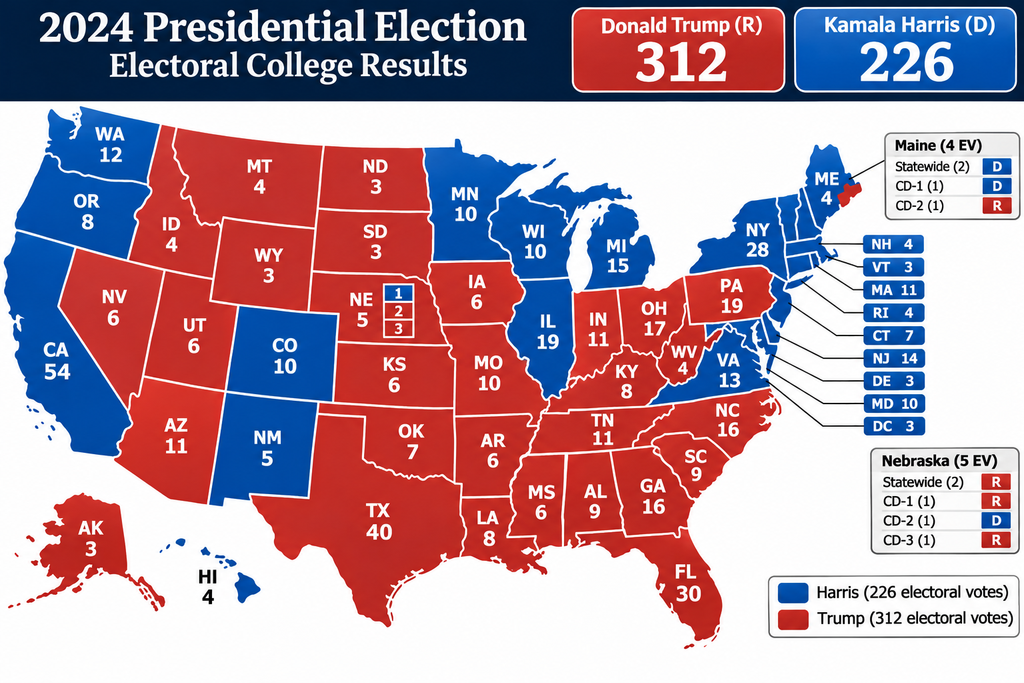
But a lot changed in two years. It’s pretty clear that the 2026 midterms were a referendum on Donald Trump’s policies, and that a whole lot of voters angrily rejected him and voted for Democrats as the alternative.
So let’s do a thought experiment to assess what the political environment looks like in 2028. Assume for the sake of argument that any states in 2028 will vote for the same party as the senators or governors that they elected in 2026. Alaska has elected a Democratic governor, so it stays blue despite the still contested Senatorial election, while Vermont elected a Republican governor, we put it in the Republican column. If there was no election for governor or senator, assume the state will stay the same as it was in 2024, and assign the electoral votes for congressional districts in Maine and Nebraska to the party of the members of Congress they voted for. And for this experiment, let’s keep Mississippi in the Republican column based on historical voting, despite the extremely close Senatorial election still being decided there.
Here’s what the map would look like under those assumptions.
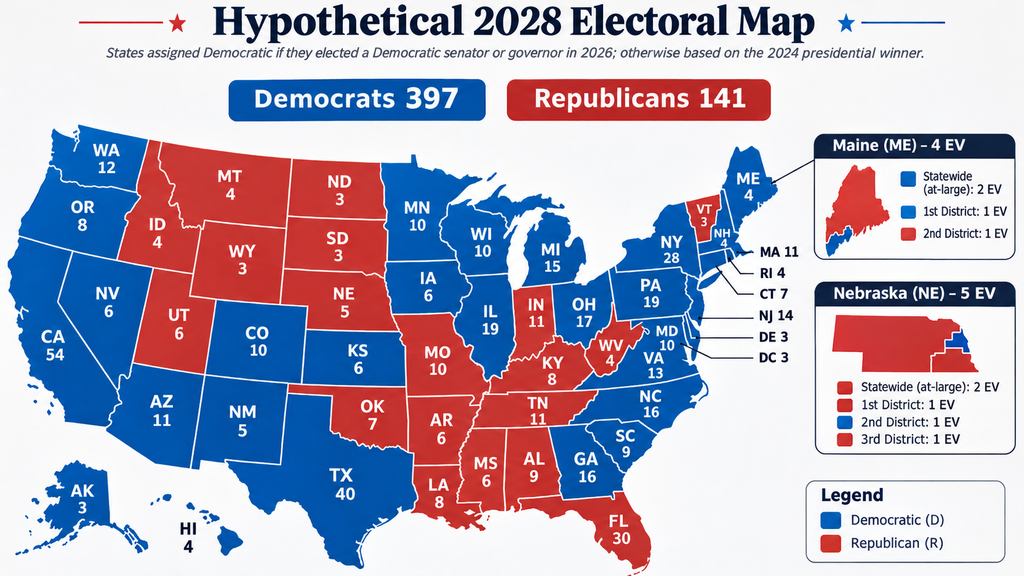
If the Presidential election followed the 2026 voting trends, this would be historical landslide for the Democrat, exceeding the totals for Barack Obama and Bill Clinton in their elections to the presidency. And it could go even further. In two of these states, Indiana and Vermont, more voters voted for Democrats for Congress than Republicans. Add in the contested result in Mississippi and the electoral vote could be 417 to 121.
Is this the actual baseline from which candidates will operate in 2028?
The total vote for Congress in 2026 reflected a D+13 electorate (13% more voters voted for Democrats than Republicans). But historically, while the midterm elections generally favor the party opposed to the President, the pendulum swings back in the succeeding presidential election. The average swing is 4%. The American electorate resists extreme swings, and voters for the President’s party who sat out the midterms are more likely to vote in the election for President. Add 4% to the Republican share and deduct 4% from the Democratic share and the result is a net swing of 8% towards Republicans, for a D+5 environment. If this happens in 2028, Texas, Ohio, Iowa, Kansas, South Carolina, and Alaska would revert to voting Republican (and Vermont would revert to voting Democratic). The resulting electoral map looks like this:
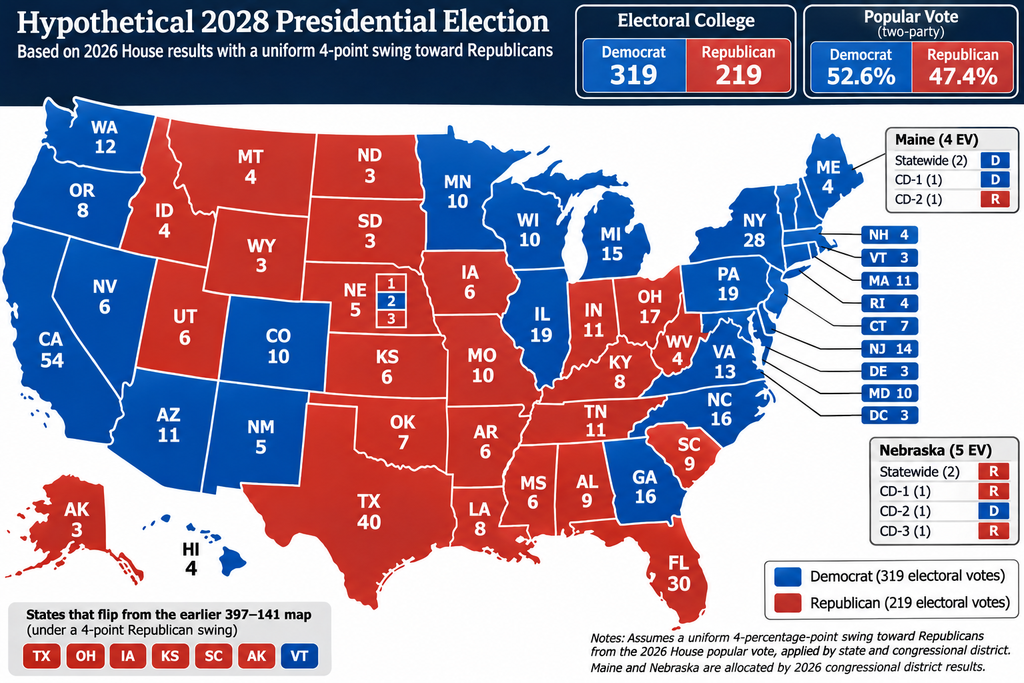
The result still strongly favors the Democratic candidate, because even with a 4% shift, the results from 2026 still exert a massive influence.
What will actually happen depends on events
If you’re a Democrat, these numbers look encouraging. But consider how thing looked for Republicans before the 2026 midterms, when the swing we saw seemed inconceivable. The electorate is not fixed. Events — like wars, gas prices, and scandals — can change people’s perception. Could voters swing back towards the Republicans as overwhelmingly as they just swung towards Democrats? It’s certainly possible.
Three things will make the difference.
- What does Trump do? Historically, presidents whose party takes a beating in the midterms change their messaging and their policies in response. This president seems unlikely to do so. If prices remain high, the Iran war continues or is resolved on terms unfavorable to the U.S., the immigration crackdown remains violent and polarizing, and Trump remains convinced that his popularity is undamaged, then voters will continue to punish Republicans for his inaction and flaws. The 2026 pattern favoring Democrats is likely to continue.
- What do the Democrats do? Starting in 2027, Democrats will control the House, the Senate, and nearly two-thirds of the governorships. If they are unable to use that power to improve the economic situation of voters, many of those voters could become frustrated and give up on them.
- Who are the candidates? With Trump unable to run for a third term, the 2028 race is wide open. Any Republican will have to steer a treacherous path between embracing Trump’s MAGA agenda and distancing themselves from failed policies. A centrist Democrat would need to fend off disillusionment from the progressive wing of the party, while a progressive Democrat could alienate voters concerned about a socialist-leaning agenda. The primary season will doubtless provide opportunities for candidates to shine or sink, and at this point, no one can predict what those opportunities will be.
The electoral environment will continue to favor Democrats, based on what happened last week. But voters respond to events. At this moment, prediction markets give the Democrats about a two-thirds chance to win in 2028. That seems about right. But anyone who lived through 2016 knows better than to bet their future on such predictions.
This is a moment when the actions of elected officials matter. Our nation’s problems remain, despite the divided government. Voters are going to judge the parties on what they do, not just what they say. We’ll be watching.