Beyond cognitive surrender; thought leaders lead; three decades of Dummies: Newsletter 18 November 2026
Newsletter 177. How can we get people to keep thinking when AI wants to do all the thinking for us? Plus, Edelman examines thought leadership, Jane Friedman gets AI-enhanced, three people to follow, and three books to read.
The cure for cognitive surrender
What is cognitive surrender? It’s what happens when a person faced with a problem to solve decides that asking an AI for the answer is preferable to thinking. Do that enough in school or in college and you never learn to think. Do it at work and in life and you remain shallow and eventually, irrelevant.
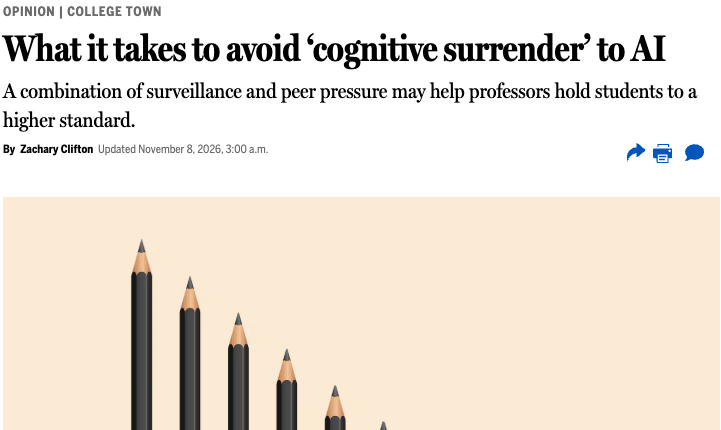
In a Boston Globe essay, Yale student Zachary Clifton describes cognitive surrender by quoting a report on learning out of MIT:
[T]hese [AI] technologies can produce “credible solutions” and “reasonable responses” to almost any written assignment in the undergraduate curriculum — essays, proofs, math and science problems, and coding assignments. And now college students, including those at the best institutions of higher education, are falling back on AI at the first sign of struggle, a habit the [MIT] committee calls “cognitive surrender.”
The report, from MIT’s Ad Hoc Committee on AI Use in Teaching, Learning, and Research Training, also found students growing isolated — skipping office hours, abandoning study groups. The committee called for a response “everywhere, and especially at MIT.”
Every university student and every professor is aware of this problem. Students start by using AI to finish assignments. The learn to use AI for everything. And they cease to engage, becoming little more than portals between the professor and the large language model.
There are two reasons this is a problem. It makes grading into a policing exercise. And far worse, it makes teaching and learning impossible. A main focus in “saving” higher education has been to fix the grading problem, but the teaching and learning problem is far more troubling.
Perhaps no one has worked more diligently to understand and solve this problem than the educator, writing teacher, and thinker John Warner. As he wrote, “everyone’s interests are aligned. Students want to learn, teachers want their students to learn and administrators are pleased if students are learning.” All we have to do is find a new way to teach and learn . . . when big AI is in every room and looking over our shoulder at every homework assignment.
There is no shortage of suggestions. Among Clifton’s suggested solutions are these:
- A policy prohibiting AI to write essays. Clifton’s writing teacher Anne Fadiman includes this guideline: “Don’t use [AI] to write your essays. Your classmates are reading them and will notice and you will look stupid.”
- “Students should be obligated to prove that they themselves wrote their essays — and how. They should be able to show their research and writing processes: their decisions to include or omit certain facts, the work of revising a thesis and its supporting evidence.” In other words, “Show your work.”
- Have students write their essays in Google Docs so professors can see how they made progress.
- Prohibit technology in any class that’s not about computers.
- Implement small class sizes and long class durations.
In my view, Clifton’s frame is too narrow, constrained by existing thinking about classes, how they work, and how they are graded. The cure for “cognitive surrender” is not just teaching students how to think, it’s engaging them in the joy of thinking.
Stop for a moment and ask yourself how a student in a practical class — say, in a vocational school learning to fix an engine — learns. The non-working engine is the problem. While there may be some classroom instruction or reading in a book or web site about how engines work, the real learning happens when the students are in front of the engine figuring out what’s wrong. They suggest a course of action. Other students argue for why it will work or not. The student tries what they hope will work, and if it doesn’t, a discussion among students and teacher happens. The “grading” is pretty simple — if you can get the engine working, you pass, if not, you fail. The engine determines the grade, not the teacher.
Is learning to think so completely different from diagnosing and repairing an engine?
I’ve taught writing to a lot of people in a lot of contexts. To teach writing is to teach (1) how to diagnose the problem to be solved, (2) how to research the solution, (3) how to plan your approach to the problem, (4) how to put words together to execute the plan, and (5) how to identify problems with what you wrote and fix it. To become a good writer is to get good at all of those tasks, with practice, repetition, and feedback. This breakdown of tasks is applicable at every level — in high school, in college, and in the workplace. The teaching and learning of writing is a continuous activity in all knowledge-focused fields, and these days, what field isn’t knowledge focused?
So we should not teach writing.
We should teach problem-solving with structured ideas and words. We should teach problem diagnosis, research, planning, drafting, and gathering and responding to feedback.
Each of these can happen in small groups with feedback from fellow students, not just teachers.
Each of these includes methods than can be taught, practiced, and learned from that practice. Each has an output that can be judged (graded?) for originality, creativity, and effectiveness. Each engages the brain, not just the prompt-and-response.
I resist Clifton’s suggestions focusing on getting rid of technology in classes and proving that you did things with your brain alone. This is not how writers work now. Writers use AI to do research. They use AI to evaluate flaws in their work. If that’s how real writers write, why must we remove technology from how they learn to write?
The problem is using technology to substitute for thinking, for wrestling with the problem, with cognition.
Students — and writers in corporate settings, too — must learn the shortcomings of too much AI use. I’m not talking about it making things too easy. I mean that the results it produces alone are lame. Teach students to identify what’s wrong with AI output and how to fix it and you’re preparing them to engage their brains and become ready for the real world.
And isn’t that what teaching is ultimately supposed to do?
(Look. I could be wrong. I bet John Warner, expert writing teacher, is going to tell me what’s deluded about this. I imagine that Jane Rosenzweig, who taught writing for two decades at Harvard, will explain how naive I am. I’m thinking that Jessica Weber Metzenroth, PhD, who teaches writing in corporate workplaces, sees it differently. If this topic interests you, well, I’ve assembled them to address this exact issue on Friday at 1PM. Sign up and listen.)
News for writers and others who think
Directly on point for today’s essay topic: Harvard Dean David Deming describes the pros and cons of using AI to help you write, according to a review of published researched. The research shows it can help you write better and teaches you, but only if you engage productively with it.
Edelman goes deep with an analysis of how thought leaders influence B2B buyers. Apparently, getting smart people to understand and recommend your product is still effective. (I’m sure you knew that, but now you’ll have statistics to back it up.)
It’s a whole lot easier to hang out a shingle with the help of AI. Read about the rise of the AI-assisted solopreneur. When the answer to every operational question is a prompt away, you can think about what you do well and how to sell it, not about the minutiae of running a business.
In a sponsored article in Publisher’s Weekly, Wiley executive editor Lindsay Berg explains how the “For Dummies” line of books is still going strong after 35 years and 8,000 titles. The analyst in me is wondering if AI, the ultimate answer machine, is going to make these books obsolete. Maybe not, because with AI undermining our ability to think, the audience of dummies is rapidly growing. Either way, it’s no coincidence that Wiley has now created a universal answer engine called dummies.ai (powered by Perplexity).
Jane Friedman makes for an interesting case study. She’s a successful thought leader focused on the publishing industry, highly intelligent, knowledgeable, and AI-curious without being a tech whiz. That’s why it was so interesting to read about how she has applied some smart AI capabilities to boost her business. (That includes turning her vast collection of smart content on the book business into a Soqratic-powered “JaneBot.“) Read this, because if she can do it, you can do it.
In The Atlantic, Alexandra Petri writes about Jensen’s Huang’s AI-assisted apology (gift link). I wrote about this last week, but her take is much funnier than mine: “I’m just wondering what training data set one would even consult in this [apology] scenario. What template was AI going to work with here? James Bond scripts? ‘I owe everyone here at Goldfinger Enterprises an apology. My fixation on James Bond and the time I have wasted designing a laser specifically targeted at his groin have distracted us from our mission of blowing up Fort Knox to increase the value of our gold supplies . . .’ “
Three people to follow
Adina Samuels , turning author ideas into books
Rachel Botsman , trust expert
Bryan Kramer , exploring the human side of business
Three books to read
Walking on Broken Glass: Navigating the Aftermath of the Glass Ceiling by Shannon Nutter and Julia C. Carreon (Practical Inspiration Publishing, 2026). Addressing challenges for women in the C-Suite.
First Encounters with AI: Writers on Writing, edited by Nina Begus (University of Michigan Press, 2026). Writers reflect on how AI is changing storytelling.
The Future of Jokes by Robin Ince (Melville House, 2026). An entertainer stares into the abyss (but funny).