How to “ghostedit” an AI-generated manuscript
AI-generated text is no longer a theoretical problem. Every writing coach, editor, and ghostwriter I know is dealing with AI-generated manuscripts from clients. I can’t yet share the quantitative results from our writer survey, but I can certainly tell you the problem is pervasive.
The solution is a technique called “ghostediting.” Before I get into what that is and how to position it, let’s look in more detail at the problem.
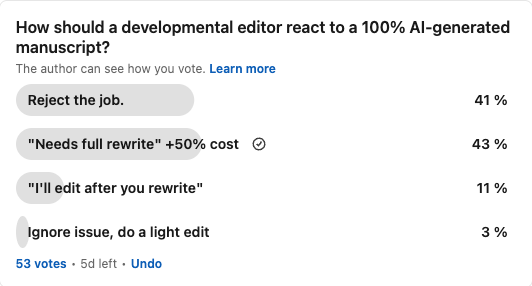
I did a LinkedIn poll on this topic. The results are illuminating:
Imaginary coping strategies
I heard comments from a lot of folks on that poll. The response from professional editors was completely different what I heard from the rest of my followers. This is because the editors have had this experience while the other observers aren’t immersed in it.
Here are some strategies that you might imagine would be effective, but are completely unworkable.
- Reject all AI-generated manuscripts. If you are an AI conscientious objector, perhaps you believe all of us editors can just refuse to participate in anything AI-generated. (Apparently, 41% of the people answering the poll agreed with that.) Our problem is that we need to make a living. If you reject all text that you believe is AI-generated, you end up opting out of perhaps 75% of your opportunities. You may feel morally superior, but your bank account will not reward your ethical purity. Very few of us can take that stance.
- Act based on your gut. As one person wrote, “Any decent content specialist (whether a writer or editor) would be able to determine if something is AI generated without using a tool.” This is a fallacy. The days of obvious AI tells are fading, and some writers are getting very clever about prompting AI tools to avoid them. “I suspect you used AI but I can’t really be sure” is not a good way to start a conversation with a client. We editorial professionals always believe we know better, but this is a case where we don’t — even if you think your sniff test is infallible, the material you’re sniffing out continues to evolve.
- Ask for documentation of process. It’s true that most people who write without AI tools can provide evidence of how they researched, drafted, and revised their work. It’s also true that asking for this is a contentious way to begin a relationship. And it’s not infallible: one way to improve drafts is to run them through AI tools and then paste in bits and pieces of recommended improvements. The writer who does this thinks they are not using AI to write, but in effect, they are.
- Ignore the issue. Why not just edit potentially AI-generated text as you would any other text? The problem with this is an unavoidable truth: the U.S. Copyright Office has ruled that AI-generated text is not eligible for copyright, and editing it normally usually doesn’t fix the problem. Publishers are now rejecting fully or partially AI-generated manuscripts. (Putting aside the reputational impact, a publisher who publishes an AI-generated manuscript has no legal recourse against anyone who wants to come out with their own pirated edition.)
- Say “you can’t fight the future” and just accept it. A highly intelligent client of mine told me, “I think very soon it will be expected one uses AI for all writing.” This is the AI manifest destiny argument, and it’s very attractive, especially to technologically sophisticated thinkers. As long as the Copyright Office maintains its stance, this analysis will run smack into the reality of publishing. Legislation could eventually change it, but that won’t help us editors and ghostwriters make a living in the current decade.
Talking with clients about AI-generated content
The first thing I do these days when presented with a potential manuscript is to run it through Pangram. Pangram is the best available tool for checking AI content. It renders a judgment of what proportion of the manuscript is AI-generated and marks which passages are likely to be AI-generated or human-created. It works by observing patterns in word and sentence usage and determining if they are closely in line with the kinds of word patterns that large language models use.
Every editorial professional should pay for a Pangram subscription plan at $240 per year. From my perspective, it’s just as essential as paying for Microsoft Word.
Pangram has a reputation for false positives. When it comes to long manuscripts, that reputation is unwarranted. It can be mistaken when looking at a 500-word essay. It is very unlikely to be wrong when observing a 50,000-word book. If it says the book is 75% AI-generated, perhaps it is only 50% AI-generated, but it’s very unlikely to be completely human-written.
Another potential objection is that AI tools can use material uploaded to them for training purposes. Pangram never trains on the material you test with it, so this is not an issue.
That said, the right approach is not to run the text through the AI detector and then contact the client and say “J’accuse!” Saying “gotcha” is not how you win over clients.
Instead, share with the client the results of the Pangram analysis. Point out that any publisher will use the same sorts of tools and get the same sort of result. The challenge then becomes, how can we solve this problem? More to the point, how can we infuse the author’s voice into the manuscript to replace the soulless machine voice it now has? The problem is defined, not as whether the client used AI, but what it would take to fix the detectable AI in the manuscript?
At this point clients may choose one of three responses:
- Go back and rewrite the text on their own and return with a clean manuscript. I have a potential client doing this right now. It’s the most desirable process, but most clients won’t have the determination to do it.
- Get upset and give up, or hire another editor. A client like this is not one you want. If they aren’t willing to address the problem, they don’t value your services. Part of my job as an editor is to present the realities of the publishing business to my clients; clients who won’t face reality are poor prospects for a working partnership.
- Hire you as an editor to fix the problem. This is where ghostediting comes in.
What does it mean to “ghostedit” an AI-generated manuscript?
One of the commenters on my post called editing AI content, “The most dispiriting editing experience I have ever had.” I continually hear from editors and ghostwriters that they underestimated the challenge and got burned — and some said “Never again.”
I too have been burned. You can learn this on your own, painfully, as I and so many other editors have in the last twelve months. Or you can learn from our experience so you don’t have to go through the pain personally.
If you and a client agree that a manuscript has a problem with AI-generated text, you need to price the revision as “ghostediting,” a term I have borrowed from editor John Robin. Ghostediting is a complete revision and rewriting of the text. It is in many ways akin to translation, rather than editing.
If you price this by the project as an editing job, you will spend far more hours than you expect and be woefully underpaid. If you price it by the hour, it’s going to take far more hours than a typical editing job and your estimate is going to be way off, and you’ll end up arguing with the client about cost overruns. If you price it by the word, you’ll find the effort is many times what you usually put in for the same length manuscript.
Ghostediting costs at least 50% more than regular editing. This is what people have been calling the “Bernoff Premium.” It’s the price of protecting yourself.
Ghostediting involves:
- Understanding the author’s voice. This work is typical for ghostwriting, but unusual for developmental editing. You must put in the time with the author to be able to write as they would, not as their AI would.
- Rooting out and fixing AI weaknesses. AI-generated text has serious problems that have nothing to do with AI “tells” like em dashes and “It’s not xxx, it’s yyy” phrasing. AI text is repetitive. It’s shallow. It’s prone to clichés. It rips off ideas without giving credit. It gets quotations and citations wrong. It’s also seductively logical, and editors need to deploy extra effort not to get sucked in. A developmental editor must engage all of their analytical abilities to determine where these problems are and how to fix them. This takes time and skill, and you should be getting paid for it.
- Rewriting most of the text. As one of my commenters wrote, “I don’t love the thought of becoming a well-paid, glorified typist.” But this is now part of the job — to revise the text so it doesn’t trip the AI detectors at the publisher. In my personal experience, this work is far more tedious and time-consuming than ordinary editing, and far less creatively satisfying than ghostwriting. You need to take frequent breaks to keep your perspective fresh. Wrestling with jello is tiring.
The editors who succeed in the next few years are going to have to become adept at ghostediting. It’s also a potential new opportunity for ghostwriters. Plenty of authors are deluded into thinking they can use AI instead of a ghostwriter. Once they figure out they can’t, they may hire a ghostwriter to do ghostediting on the slop they created.
Technology always creates problems. It also creates opportunities. If you’re a skilled editor or ghostwriter, you’d better be aware of the best strategies to deal with AI-generated text. Because, like it or not, you’re going to be seeing a lot more of it.
And if you’re an author, trust me, we’d really much rather be editing your personally authored, imperfect manuscript than a polished collection of AI-generated mush.
Good post, Josh. One quick point for editors who only work on occasional projects: It may be cheaper just to create a Pangram API key and invoke it as needed with Claude Code or a comparable AI application. (It’s not hard.) Of course, those who routinely work on large projects will probably find the annual plan more affordable.