Answers to authors’ questions about AI-generated content and copyright
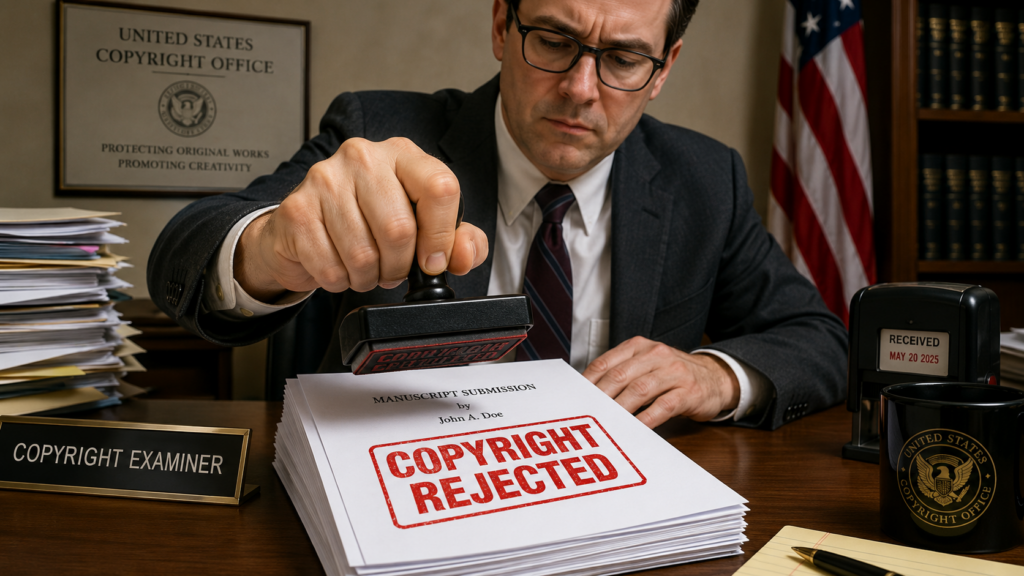
You’ve likely read that the US Copyright Office doesn’t grant copyright protection to AI-generated content and that the US Federal Courts are following that ruling. But how can they tell what’s AI-generated? And since so many authors use AI to help produce their manuscripts in some form or another, what’s the author’s actual risk here?
The basic story here is this: Publish AI-generated content and you’ll be in for a world of trouble. There are other well-documented risks, such as the risk of publishing AI-generated falsehoods (“hallucinations”) and misattributed or invented quotes, plus of course the risk that your prose will be lame and terrible. But what’s the actual legal risk?
I’ll try to answer these questions for you. (Keep in mind that I am not a lawyer — check with your publishing lawyer for more definitive answers.)
Why do you need copyright protection?
You might ask, can I get away without securing copyright protection? After all, people publish content without copyright all the time — there’s even a Creative Commons license classification, CC0, for content that you put right into the public domain.
But no publisher will publish a manuscript without copyright protection. Regardless of whether you retain the copyright or the publisher acquires it from you, the publisher’s agreement with you contains a clause that gives the publisher the exclusive right to publish your manuscript. This is true regardless of whether you use a traditional publisher or a hybrid publisher. Without copyright protection for your work, anyone can legally copy it, distribute it for free online, or create and publish their own version. The publisher needs exclusivity to protect itself from this sort of competition, a reasonable requirement since they’re taking the risk of publishing your manuscript. Publishers don’t publish commodity content; there’s no profit in it — in part because readers won’t buy a book that they can legally obtain for free.
You can, of course, self-publish. But now you’re subject to the same competition as a publisher — other people ripping off your work and doing whatever they wish with it.
So while it’s not a legal requirement to obtain copyright protection before publishing, it’s a practical requirement to protect yourself, your work, and the interests of your publishing partners.
Does the copyright office scan content for AI?
No, there’s no technical AI scan at the Copyright Office. However, when you apply for copyright, you need to specify what content was original and authored by you, and what was not. The parts that are not are excluded from copyright protection.
If you say that your work was written by AI, the Copyright Office will not grant it copyright registration. If your work was partially written by AI, then only the parts authored by humans can receive copyright protection.
Couldn’t you lie to the Copyright Office about how you created the work?
Certainly, you could tell the Copyright Office that the work is original, even though AI wrote it. And maybe you’ll get away with it.
But if a credible third party offers evidence that the work was written mostly or completely by AI, the Copyright Office could revoke your copyright protection based on that claim. The Copyright Office could even assess a fine of up to $2,500 for your having made a false representation of a material fact in your application.
What will your publisher do if you used AI to create part of what you publish?
Publishers are increasingly requiring authors to specify how they used AI in the creation of their manuscripts. If you used AI to generate publishable material, you’ll have to disclose it. And if it’s a significant part of the manuscript, they’ll block or retract the agreement to publish, in part because you will have put your copyright in jeopardy.
This is probably what happened with the novel Shy Girl, which the publisher cancelled after determining that significant amounts of the manuscript appeared to have been created by AI.
If you’ve lied to the publisher, they’ll have grounds to cancel your publishing agreement based on your having signed a false statement. There may even be grounds for them to go after you for damages if they incurred significant expenses based on your false assertion of authorship.
Are there other dangers from using AI?
Yes. Amazon has already said it will not carry books that falsely claim authorship when they were primarily authored with AI.
There is also reputational risk. Your visibility as an author will be damaged if there are credible claims that you used AI to write your book. I’ve already seen cases where authors accused of such actions accrue a slew of negative reviews based on the bad publicity.
In what ways could you use AI without endangering your copyright?
I investigated this in my study of “AI and the Writing Profession” and when I worked on the AI Guidelines for Ghostwriting. The main problem occurs if you use AI to generate content that gets into the final manuscript. If that’s a significant portion of the manuscript, especially if you fail to disclose it, you’ll running the risk of losing your publishing contract or your copyright protection.
Authors commonly use AI for these tasks, which are far less likely to get you into trouble:
- Transcribing audio interviews (but you’ll want to double-check what you publish against the audio for accuracy)
- Checking spelling and grammar
- Cleaning up formatting or citations
- Suggesting words or appropriate terminology (as a thesaurus)
- Reviewing text to identify inconsistencies, redundancies, and other flaws
- AI-augmented web search (which is now the default for Google)
- Producing extensive research reports for background (but check what they find against original sources for accuracy)
- Summarizing papers or other content for research purposes (but again, check what they find against the original paper)
- Using AI tools as thought partners in discovery, ideation, and brainstorming
- Suggesting titles and headings
- Compiling and querying repositories of relevant content (but check results for accuracy)
AI can help you think. But you can’t trust the accuracy of anything it tells you. Fact-checking is still the author’s responsibility. And if any of the text it generates finds its way into your manuscript, that generates both copyright and reputational risk.
I’d recommend that you clearly state how you used AI, both in the back of your book and in your statements to the publisher.
If you’d prefer to hide what you did, what will happen when somebody figures it out?
AI can be a huge help. Just don’t use it without understanding the risks, including the risk to your ability to copyright and publish your work.
Note: Paul Sennott of the publishing law firm of Sennott, Williams and Rogers contributed legal insights to this post.