Writing as code; an AI-augmented bestseller; authors as narrators: Newsletter 29 July 2026
Newsletter 161. Writers have always used text as a sort of code, to program the mind of the reader. Can AI do that better? Plus, deciphering publishing jargon, a college where the instructors are chatbots, troubling questions about the thriller Daggermouth, three people to follow, and three books to read.
Prose is code
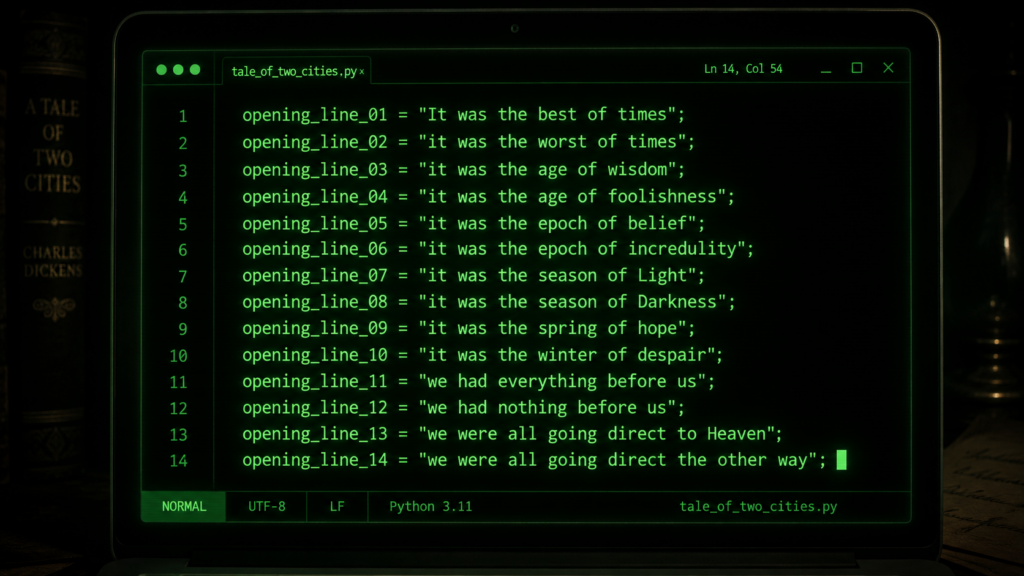
Large Language Models are programmed in English. That’s the “code” we use to tell them what to do.
This is not new. Writers have been coding in English forever.
The purpose of writing is to create a change in the mind of the reader. You want the reader to feel something, to believe something, to act on something.
Effective writing is writing aimed at an audience, for a specific purpose, intended to generate a specific action and impression. (I wrote about this ten years ago: Readers, Action, Objective, iMpression. It’s still true.)
Every choice you make as a writer is about what makes writing more effective in moving your audience.
You start with a story because that draws people in.
You write briefly because people’s attention tends to wander.
You choose evocative words to captivate a reader’s attention.
You gather and present evidence to make people believe you.
You embrace clarity to more precisely describe what you want that reader to believe, and to do.
This is code. Written language is a programming language. Readers’ minds execute it. Then they act on it. It’s not deterministic — you can’t know how each reader will react, nor will they all react in the same way — but it is effective. If they change and act as you expected them to, you’ve succeeded. If they don’t, you need to figure out what’s not working. You need to debug your prose.
This approach is most obvious in marketing writing: You test the copy, measure the results, see if it causes the desired action, and make changes to improve the yield. But at a base level, other forms of writing are similar. The only difference is, we don’t formally measure the reader response. But we still observe what works and make changes.
It used to be true that the only people who could write were humans. Just as it used to be true that only humans could write software code.
Now, of course, machines write software code all the time. And, as the widespread wailing and gnashing of teeth from professional writers reflects, machines write text, too.
Forget art. The key question is, are LLMs as effective as human writers at writing that moves people?
If the LLM is writing instructions on how to use a washing machine, probably.
If the LLM is writing formulaic marketing copy, maybe.
If the LLM is writing a hackneyed romance novel, conceivably.
If the LLM is writing an essay intended to inspire and persuade, not yet. As humans, we are better than machines at applying the code that is English prose to delight, tantalize, shock, inform, enlighten, and persuade people. Readers rebel at prose they perceive as generated by a machine. They want to feel a human connection with a writer. They want you to inspire them, not your text output.
But the machines are getting better and better at writing. If they’re able to crack the code on connecting with people (or simulate it closely enough), writing will cease to be a profession and will become a hobby, like painting or singing.
Am I a good writer because I am fully human?
Or is it because I’m skilled at creating the prose code that people relate to?
If it’s the latter, then my days as a professional writer are likely numbered — and so are yours.
News for writers and others who think
Jonathan Jordan‘s quick reference on publishing jargon will help authors feel less like a foreigner listening to a strange language.
I was fascinated by this Wall Street Journal article about the radically new design of the windowless, blended-wing JetZero aircraft (gift link). But as cool as the design is, the most radical thing in the article was that the company brought its potential customers together and then let them speak privately with each other about about what they like and dislike about the product. That takes courage, but it appears to be generating powerful customer insights.
Maris Kreizman considers who should narrate an audiobook: the author or an actor? In LitHub.
Could a college replace human instructors with chatbots? Yes. That’s apparently how Maestro College works. Unsurprisingly, it’s awful at almost everything except extracting money from students through loans and grants.
In The Atlantic, an analysis of Daggermouth, a bestselling novel with a suspiciously high concentration of apparently AI-generated prose (gift link).
Jill Archie explains how to write an effective book description (for Amazon, for example)
Three people to follow
Sara Rosinsky , a truly creative copywriter
Melanie Dusseau , thoughtful academic opining on writing, teaching, and AI
Erik Deckers , crackerjack content marketer and ghostwriter
Three books to read
We the Patients: Understanding, Navigating, and Surviving America’s Healthcare Nightmare by Matthew Zachary and Jen Singer (Wiley, 2026). Radical and effective hacks to get the healthcare you need, when you desperately need it.
The Reverse Centaur’s Guide to Life After AI: How to Think About Artificial Intelligence—Before It’s Too Late by Cory Doctorow (MCD, 2026). One of the 21st Century’s top thinkers presents a gimlet-eyed view of why AI is crushing creative workers and what we should do about it.
That Book Is Dangerous!: How Moral Panic, Social Media, and the Culture Wars Are Remaking Publishing by Adam Szetela (MIT Press, 2025). Is publishing censoring books that don’t match its moral standards? Should it?