Why I don’t trust Mark Zuckerberg and his “AI future for everyone”
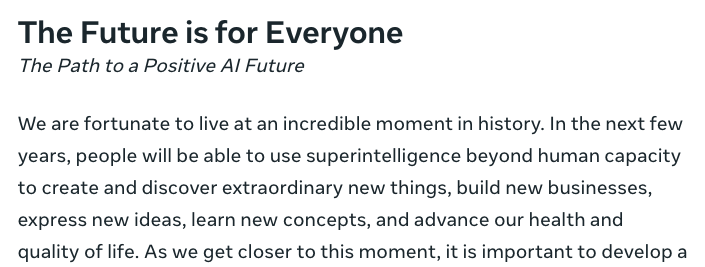
Yesterday, Meta CEO Mark Zuckerberg released a 6,500-word statement titled “The Future is for Everyone: The Path to a Positive AI Future.” It is hopeful and utopian. I don’t believe it. After you read this, I expect you will be suspicious as well.
There are two historical principles here that you should be aware of.
- In any competitive technology market, leaders prefer to keep their technology proprietary to maintain their advantage. Competitors who are behind always argue for open standards, because that erodes the leaders’ advantage. Most analysts rank Meta’s AI in a third tier, behind OpenAI/ChatGPT, Google Gemini, Anthropic (first tier) and xAI (second tier). So it’s not surprise they’re in favor of open standards.
- Mark Zuckerberg has a history of making pro-social utopian statements about technology even as his company Meta behaves in anti-social ways. His high-sounding
“we are all a community” types of statements cover for policies that promote the most venal, divisive, exploitive, and mentally unhealthy algorithms in the world.
So, yes, I go into this analysis with a cynical perspective.
Maybe you’ll be cynical too after you read what I’ve noticed about his statement.
(One aside. I put his statement through Pangram. It rates the statement as 100% human-authored. I’m sure he used AI to help, but he also likely has the best possible corporate ghostwriters covering his tracks.)
Analyzing Zuckerberg’s statement
In what follows, I’ve quoted elements of Mark Zuckerberg’s statement and added my own commentary.
As we get closer to this moment, it is important to develop a philosophy for how we can best use superintelligence to ensure it improves all of our lives, work, communities, freedom and safety.
Note the use of the term “superintelligence” for advanced AI. I’m certain Meta and Zuck chose this term after market-testing alternatives to choose terminology that is as friendly and helpful as possible. The common alternative “Artificial General Intelligence” sounds a whole lot scarier, wouldn’t you agree?
The defining questions of our age are who will have access to superintelligence and what will we direct it towards. Will it be centralized and restricted to a few institutions, or will it be a tool that empowers everyone?
If you are a leader like OpenAI, you want to restrict access to those who pay. If you are a laggard like Meta, you want to “empower everyone” to improve your competitive position.
We propose a philosophy based on individual empowerment as the source of prosperity, invention as the primary purpose of superintelligence, and balance of power as the foundation of safety.
This sounds a lot like the pro-community language that Zuckerberg shared to distract everyone while Meta deployed the most pernicious and divisive social algorithms.
All new technologies create opportunities and challenges. Superintelligence will be among the most important technologies in history, so its opportunities and challenges will likely be greater than any we’ve seen in our lifetimes. We should take this very seriously.
This is what’s known as a meaningless platitude. That is, a generic statement that is obviously true, everyone can agree with, and has no actual substantive meaning.
Still, it is surprising that the discourse from many developing AI is so filled with doom. I do not understand why anyone who believes that AI will eliminate most jobs and much of humanity’s relevance would rush to build that future. The notion that AI is so dangerous that the only safe path is an extreme concentration of power seems inherently problematic. Historically, hoping that an absolute power will benevolently provide for humanity if sufficiently enlightened has not led to safe or positive outcomes.
This is hopelessly naive. The people building AI do so because they are generating a tool that is so powerful that they can sell it at a profit. The people in companies who adopt the tool and use it to eliminate jobs are doing so to increase their profit margins and boost their share prices. It’s not really all that complicated. Casting it in idealistic terms is a distraction. AI creators are capitalists, and so are corporate AI users.
Humanity has witnessed many transformative advances. Each time there is fear that people will be left behind. But each time humanity has come out with more people sharing greater prosperity, health, and freedom. We believe this will be true with AI as well, and the abundance of the future can be shared by everyone. We also believe that the values that got us to this point — like liberty, open inquiry, free enterprise, and equal opportunity — are also the right values to build a positive future.
Don’t worry. Technology is always a force for good. Ask the people in London who breathed sooty air and worked insane hours for crap wages in the industrial revolution. Ask the workers Amazon is working to death. Ask the American voters who’ve become hopelessly cynical as polarizing lies spread across social media. Ask the patients whose treatments are withheld by insurance companies’ AI algorithms. Read Cory Doctorow’s definitive treatise on how technology turns everything crappy: Enshittification. Liberty, open inquiry, free enterprise, equal opportunity, and technological innovation don’t always lead to a better future.
Putting power in people’s hands to pursue their own aspirations is how humanity has made the most progress. Novel ideas and major steps forward rarely originate from established institutions alone. They came from the brothers in a bicycle shop who believed people could fly, the bookbinder’s apprentice with no schooling who figured out how to generate electricity, and the kid in a garage who thought personal computers could be for everyone. We believe this will continue to be true. As everyone gains more powerful tools, each person will become more capable of shaping the future, not less.
AI empowers new entrepreneurs. It doesn’t stop them from getting huge and exploitive. This is the gospel of “disruption” — find a way to use technology to gain customers and disempower incumbents, then turn yourself into a huge, valuable, and powerful company making insane profits by exploiting workers and customers.
Rather than centralizing superintelligence, we should distribute it widely and give every person the ability to direct it.
If you were a third-tier AI provider, this is exactly what you would say. See point 1 at the top of this post.
It will have strong privacy and security options so you can trust it to handle all of your personal content knowing that no one else can access your information, . . .
Tell us everything about you. Then trust us and an AI whose motives you can’t scrutinize to keep that all safe. What could go wrong?
We will offer free versions that will be accessible to billions of people.
Who pays for free technology? If it’s free, as the saying goes, you are the product. AI will be no different.
But if the power of superintelligence is held by a small number of individuals, businesses, governments, or AI itself, then that will naturally lead to outcomes that are less favorable for everyone else. This is not a technological principle. It is about the balance of power. There is no such thing as a singular benevolent superintelligence.
Therefore, the key to a positive future for everyone is achieving a balance of power that favors individuals. The solution is to ensure that superintelligence is broadly distributed to empower people.
This is what you say when your AI is in the third tier and you need to win back an edge against the rest of the market.
Meta’s mission since our founding has focused on putting power in people’s hands.
Do you use Instagram, Facebook, or Threads? Is this how you feel about those tools?
Recent statistics suggest it may be more likely that individuals’ capability growth could match or outpace automation, in which case people will gain the ability to do many new things before their current jobs change. This would lead to a healthy balance and potentially even job growth.
Tell this to all the coders who are now out of work.
Yet one significant disadvantage that the US has compared to countries like China is that it is more difficult to build infrastructure here. So we would all benefit together by figuring out the Community Compacts required to enable sustainable development across the country.
It’s a very old playbook. Don’t regulate us or China will get ahead. And I’m sure this message is being heard loud and clear in Washington.
Over time, I expect that widely deployed AI models with strong cybersecurity capabilities will lead to systems that are more secure, not less. This will be definitively true once superintelligence enables most of the world’s code to be verifiably secure. The long term answer isn’t to withhold capabilities but to establish a balance of power where superintelligence is broadly distributed.
If everyone has a bazooka and a machine gun there will be less violence. Can’t you see that?
Given how dynamic and competitive the AI landscape is, I think it will be more productive to have a close proactive collaboration between frontier labs and the government rather than a rigid process and review timeline that is followed in all cases. In some cases, American labs may extend our lead by more than a few months and taking more time to mitigate new risks may lead to safer solutions. In other cases, delaying releases by even a month may cede America’s lead and create worse outcomes.
Trust us, don’t regulate us. It will be fine. Again, let’s not allow regulation to disadvantage American companies.
The ultimate question of balance of power is how humanity will maintain power and control over AI itself. The concern is that AI may gain enough power or control to the point where at best it no longer serves humanity’s interests and at worst puts humanity in peril.
A healthy balance of power is to ensure that there is no singular centralized superintelligence, but instead as many people and businesses as possible with different superintelligent agents aligned to their goals that check and compete with each other in the ways our natural economy behaves. This balance would be further enhanced if there were multiple frontier labs whose models have different values that could check each other as well.
Let’s all set our good AIs to defend against evil AIs. What could go wrong?
To ensure people remain in control, the significant majority of intelligence must be directed by people towards advancing people’s goals. This means that Meta, other frontier labs, and clouds committed to giving people a greater balance of power must collectively build out a sufficiently large amount of compute such that we can allocate enough to recursive self-improvement to remain competitive while still committing the significant majority towards people’s individual goals.
I’m just wondering how this is going to happen. The first sentence is in passive voice, and that’s not a coincidence. Because nobody knows how to enforce this, and no one is in charge.
Meta is implementing a governance structure that gives our independent board of directors the power to approve the safety criteria for releasing models and reviewing whether each model release adheres to the criteria.
Meta has a history of creating “independent” boards to regulate its behavior and then ignoring the recommendations of those boards. It’s a great way to pretend you can “self-regulate” without empowering anyone to overrule company decisions.
Beware AI companies bearing gifts
Don’t trust big tech.
Don’t trust Meta.
Don’t trust Mark Zuckerberg.
This isn’t the first time we’ve heard meaningless platitudes like this. And it won’t be the last.
Excellent post, Josh. You’re going to have to rinse off your boots now… I just finished reading Doctorow’s “Reverse Centaur.”
Zuck wouldn’t be arguing for open standards if his company’s ill-advised $80B bet on the metaverse paid off (https://yhoo.it/4xxr9gK). Motivated reasoning at its finest.
This essay took my breath away. As a writer and creator, I feel a great debt to you for doing the research, the unpacking of these grandiose missives by big tech founders and revealing the truth behind AI. Two words: thank you.
Silicon Valley types either convince themselves that everyone else wants what they want, or they pretend it’s true and make consistenly bad-faith arguments, as you show here. Tech culture is “move fast and take things.”
THANK YOU!
It may be the way I think, but I usually look at what people do, not what people say. The former is usually a more accurate prediction of what they will lately do. The latter is cheap, especially in the case of a multimillionaire.
I have saved this for re-reading later :-).
And am I the only one who caught the grammatical error in the title?
The Future is for Everyone
Should be:
The Future 𝐈s for Everyone if he’s using title case.
Grounds for dismissal!
I never realized linking verbs and all verbs were capitalized. New day just dawned. Thank you, Mr. Simon.
“Foreign labs currently hold several advantages here since American labs have to comply with many additional restrictions on training data. US policy must reduce this additional friction if we want American open source models to lead over time.” my translation I am angry that courts are not allowing me to steal others work wholesale without any compensation or consent! Agreed Josh I do not trust Mark Zuckerberg he has already proved untrustworthy with the damage he has done with his products to the American political process and society.
In my experience with no-code automation, the key is choosing tools that integrate well with your existing stack. Compatibility often matters more than features.