What to do about “The End of Reading”
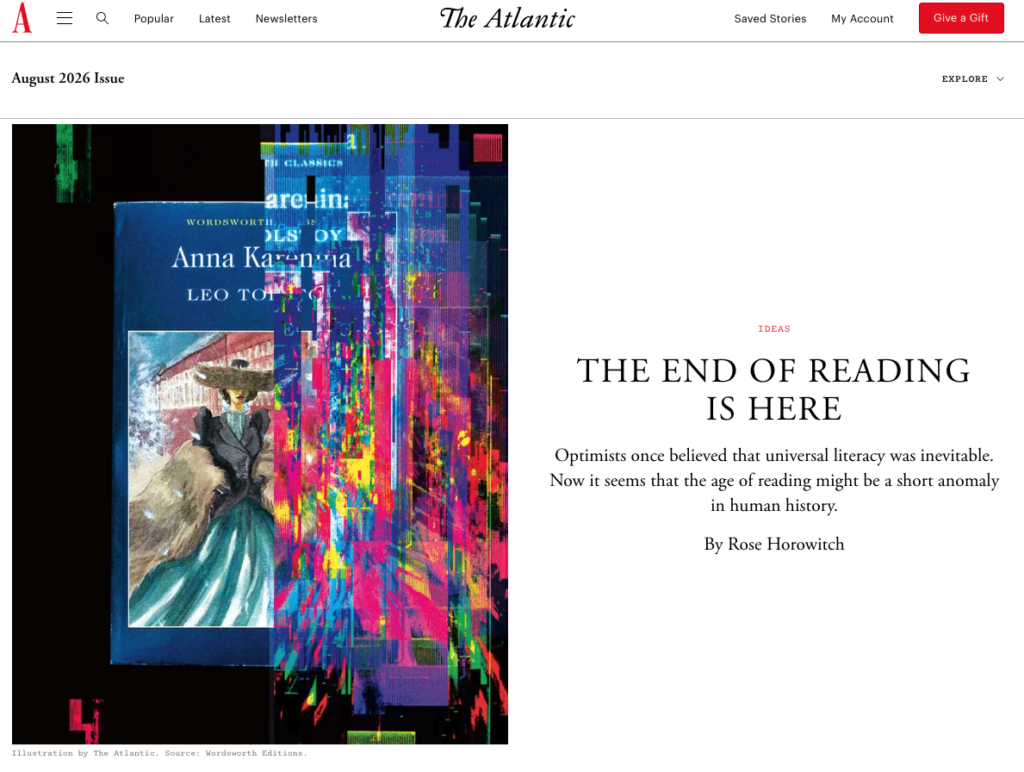
In The Atlantic, Rose Horowitch has written an essential and terrifying article describing what she calls “The End of Reading.” I enthusiastically encourage you to set aside 15 minutes and read it.
Thinkers have been decrying the end of reading for many decades, citing causes from television to video games. That doesn’t make Horowitch wrong. There is a real and measurable decline, and it is correlated to the endless scroll and video torrent to which we are all addicted.
These passages made an impression on me:
And yet, strangely, Americans are probably reading more words than ever before. What has changed is what they read, and how. People are bombarded with emails, text messages, X posts, Reddit threads, Instagram captions. This explosion of textual fragments has come at the expense of devoting sustained attention to longer written works that convey rich and complicated information. Maryanne Wolf, a cognitive neuroscientist at UCLA, argues that people are losing the ability to think deeply about writing. That doesn’t mean they are forgetting how to decode individual words. Rather, they are losing the higher-order abilities of comprehension and synthesis. America, in other words, isn’t illiterate. It’s postliterate.
Reading is more than a skill, or one mode of communication among many. The media we use to interact with one another shape the world we inhabit. . . . The decline of reading will bring about changes of the same magnitude. It will affect our innermost thoughts, our society’s politics and culture, and how we tell the history of our civilization.
[T]he doomsday scenario has arrived: A return to text, away from video, seems awfully unlikely. Maybe McLuhan and Postman weren’t wrong in predicting that our society would become postliterate. They were merely early. The world that these theorists foresaw half a century ago is now here. The literate era will prove to be a brief interlude between the oral and digital ages.
A number of digital technologies have hijacked attention and made focused reading all but impossible. Generative AI is the first tool to threaten the continued existence of writing.
Writing is hard because the writer is learning. If AI eliminates the challenge, it also eliminates the learning.
What’s at risk is nothing less than the ability to think for oneself. If people become overreliant on AI to write for them, they could lose the capacity to interrogate or even develop their own views. These are quintessentially human capacities. “If we gave those up,” the NYU philosopher Kwame Anthony Appiah told me, “we’d stop being the kind of humans that we are. We’d be very different creatures.”
What to do
I lack the arrogance to believe I can change this inexorable trend. Technology seeks audiences. Audiences seek entertainment without effort. Reading and writing require effort. Someone younger and more energetic than me could perhaps try to reverse this trend, but I’m a writer, not an engineer of social change.
What I can do is help you, personally, to invest in the part of you that reads, writes, and thinks.
Here’s all you have to do.
- Buy (or borrow) and read print books, for education and for enjoyment. Keep stimulating the part of your brain that reads and then thinks. If you keep thinking, you’ll become part of the elite that can do so. We need that.
- Write. Every day. Journal. Blog. Post. Respond. Don’t use AI to write; that’s as silly and ineffective as replacing a daily run with driving because it’s easier. At 67 years old, I can tell you that my daily blogging habit is likely the reason that I can still reason and think and come up with new ideas. What you don’t exercise will atrophy.
- If you have young children, read to them. Read board books and picture books and chapter books. Children whose parents read to them learn to associate reading with quality time and love. They learn that books are a source of fun and imagination. They want to be able to do for themselves what you are doing for them. We did this with our children; one is an abundantly creative writer for work, and the other, while dyslexic, has become a startlingly analytical and thoughtful human.
This may not change the world. But it will change you and the people you care about in ways that matter.
Readers think. Writers think. And the world could certainly use a little more quality thinking right now.
Does the article address the potential contradiction of folks buying more books, but maybe not reading?
I am not convinced this is new. My two oldest kids 35/31 definitely had books to read at home and school (and trips to the public library), but hate reading. There were not widespread personal e-devices, but of course distractions and attention-grabbers are much older than all of us.
Interestingly, I used to read The Atlantic every issue, but their critical thinking slipped greatly and I opted out. I will read this article.
Studies have shown that reading printed content uses a different part of the brain than does reading electronic content. These two different modes of reading wire the brain differently. I’m not one to say if one is better than the other. I do say that, having grown up and spent most of my 72 years exposed to print-only content, I prefer it.
In the past year, I have visited a rehab center in southern Maine several times, just to read aloud to the residents, as part of the facility’s cultural enhancement programming. Reading aloud to others is a collaborative exercise, not designed exclusively for children. It doesn’t matter what I read – favorite stories of yore, entertaining newsletters, short-story classics – the audience invariably enjoys and appreciates it. It stretches the brain through the ears, too. Listening is a fading art.
A print book is a lovely thing – it won’t evaporate, no matter how long it sits in the to-be-read pile – and regardless of the topic, it enriches the intellect. Every book contains something of value.