Virtual book coach; CBS’s Streisand Effect; Reading for pleasure: Newsletter 7 January 2026
Newsletter 130. I, Robot. Plus why spiking that “60 Minutes” story backfired, what people do when they should be reading books, three people to follow and three books to read.
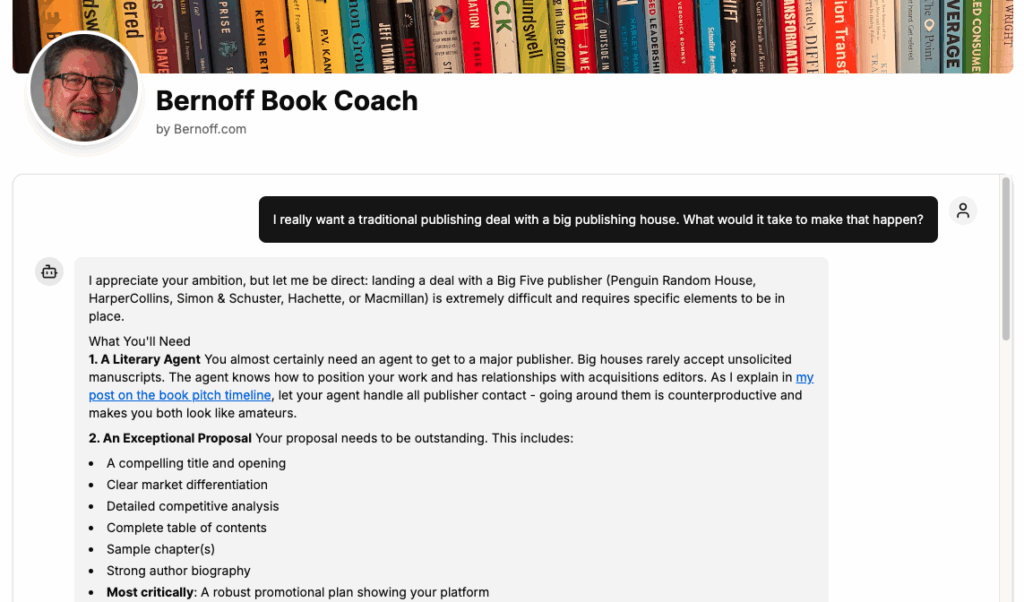
Why I turned myself into a chatbot
My mission is simple:
- Learn everything possible about nonfiction books, authors, and the writing process.
- Share that knowledge as broadly as possible.
- Help authors succeed.
I’ve wanted to write a book since I first learned to read. Helping others write and publish books is now my life’s work, and it’s truly rewarding.
There’s only one problem. How do I get the insights I have to the authors who need them at their moment of need? Could AI help?
My blog has 2,800 posts and 4 million words of insight. You can search it. But that’s hit-or-miss and inefficient. And my two books on writing have indexes at the back, but if you don’t guess the right topic, you might not find what you’re looking for.
You can, of course, hire me as a book coach. Those relationships are rewarding to me and, I hope, to my clients. But that’s expensive and requires us to coordinate our schedules. It’s not “on demand” — it can’t be.
This was my mindset when I approached the folks as Soqratic, a company that makes chatbots out of author content. Having used ChatGPT and its competitors to find answers, I reasoned that it wouldn’t be that hard to turn my own content into a knowledge base that anyone could ask questions of and get useful answers.
It was a lot harder than I thought. The reason is that I wasn’t doing this just for me. I wanted a chatbot that anyone could sign up for and use, that would only give answers that I would give. That meant it had to have these qualities:
- Based exclusively on my own content. If you query ChatGPT with “What would Josh Bernoff say about topic x?”, it tends to mix in general web content with my answers. And, of course, it hallucinates. I wanted my bot to be purely, clearly, and exclusively based on my own insights. I insisted that all answers should include a link to blog posts or book chapters where I discussed the topic.
- Addresses both factual and emotional issues. Real authors want to know “How much does it cost to use a hybrid publisher,” but they also want answers to questions like “Why is it so frustrating to work with a coauthor?” My content addresses both, so the bot would have to as well.
- Free from bias. No ads. No skewing results. I’m scrupulously balanced; my bot would be as well.
- Personalized. My coaching relationships work because I get to know my clients. The bot would be the same. If you told it you were working on a book on career paths for Gen Z and you wanted a book of 45,000 words, it should give you answers based on that knowledge.
- Easy to sign up for. This turns out to be the hard part. Getting all the financial and technical plumbing in place to make the signup process effortless is way harder than you might think. I wanted to be sure that I wasn’t going to spend all my time dealing with users having technical glitches.
The whole point was to create a tool that would allow anyone to ask any question about books and writing and get an answer based on what I’ve written before. Because I’ve written so much on topics of interest to authors and other writers, there’s a vast collection of source material. You should just be able to ask a question and get a reasonable answer.
In an ideal (fantasy) world, it would be free. That’s what we’ve been conditioned to expect. But access to LLM applications has a price; every query would actually cost my partners and me money. More importantly, I wanted authors to understand the value of what they were getting. Instant access to 4 million words of highly relevant insight on exactly the topic you need should be valuable enough to pay for.
But I did make it extremely cheap. Unlimited access to the Bernoff Book Coach is $1.99 to get started and $17.95 a month after that. If you hired me for advice, you’d be paying $400 an hour. For unlimited queries, that’s a bargain.
I’m very pleased with the result. My alpha testers and I have tried to stump it with all sorts of queries about books and writing, and it always comes through. Try it; let me know what you think.
And one more thing. If you’re an author, all this may make you wonder if you turn your content — books, blogs, podcasts, newsletters, Substacks, and so on — into a coach. Soqratic‘s objective is to make setting that up as easy as possible. As soon as the Bernoff Book Coach gets going, we’ll be helping lots of other authors make their own versions.
I help authors succeed. Helping them turn their knowledge into revenue-generating chatbots is about to be part of that mission.
News for writers and others who think
The decision that CBS News made at the last minute to spike its “60 Minutes” reporting on CECOT, the infamously Salvadoran prison, backfired in spectacular fashion. The report aired in Canada and subsequently spread broadly (can you say “Streisand Effect”?). If it ever appears in an edited form on CBS “60 Minutes,” media analysts can compare it to the original version and see what the new management at CBS has censored. Regardless of what you think of the decision to spike it, the execution was strategically stupid.
The Bookseller published a roundup of publishing industry predictions from publishing company CEOs. Most fundamental observation from Harper Collins CEO Kate Elton: “The decline in reading for pleasure is undoubtedly the most urgent issue facing our industry.”
Nonfiction sales are down. The Guardian points out that readers seeking nonfiction have an infinite supply of content, from podcasts to TikTok. After authors stop rending their garments, they can take away this point: Unless your book has a startling point, is written in a diverting way, and is promoted cleverly, you’re going to have a hard time getting it in front of distracted readers.
Three people to follow
Nir Zohar , president of Wix, who just called all his employees back to the office 5 days a week
Salwa Emerson , founder, No One Joins a Cult
Simon Sinek . Start with Why. Finish with an opinion on just about everything.
Three books to read
The Laws of Thought: The Quest for a Mathematical Theory of the Mind by Tom Griffiths (Henry Holt, 2026). Before you ask if AI can think, you must ask how we think — a surprisingly difficult question.
The Greatest Sentence Ever Written by Walter Isaacson (Simon & Schuster, 2025). “We hold these truths to be self-evident, that all men are created equal . . . ” Who wrote that and how did it come into being?
Unhinged Habits: A Counterintuitive Guide for Humans to Have More by Doing Less by Jonathan Goodman (HarperCollins, 2026). Don’t change yourself. Change your goals to match who you are.
Curious about two things:
1) Why would not someone download the entire contents in month one? Huge fan of getting paid for one’s work. I’ve heard folks do this in other projects and wonder why everyone does not do it.
2) What do you mean by free from bias?
Thanks and Congratulations!
1) You can’t “download” the contents of a chatbot. You can only ask questions of it.
2) Free from bias simply means that it’s not ad-supported, nor is it presented by an obviously biased entity like a publisher, an agent, or a publicist. I guess I have biases, but in general my goal is only to help authors, regardless of whether that’s good or bad for others in the publishing ecosystem.
Thank you.