The book pyramid; Gates on AI; scam taxonomy: Newsletter 2 September 2026
Newsletter 166. Buyers see books from the top down, so that’s how you should build them. Plus, the end of MIT Sloan Management Review, Google makes eBooks queryable, three people to follow, three books to read, and one writer survey to take.
Authors must understand the view from atop the pyramid
How does someone choose a nonfiction book to read?
First they need to find out about it. They might read a review, get a recommendation from someone they know, or spot it in a bookstore (online or physical). So now they’re observing the actual book or scanning its page in Amazon or Bookshop.org.
A book is a substantial collection of content, tens of thousands of words. If that grand collection of content is poorly organized, the potential reader has no way to get their head around the question “What is this? Is it worth my time?” They move on, and you’ve not only lost the sale, you’ve lost the opportunity to influence them.
What I’m about to write explains how book buyers and readers make decisions — and after that, I’ll explain what you, an author, must do to make those decisions persuasive for your audience.
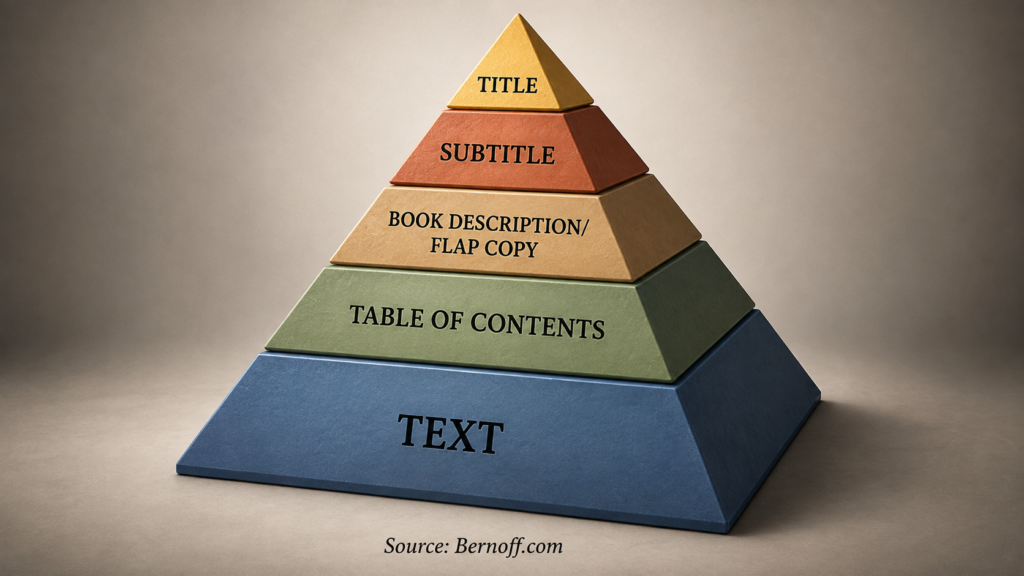
To start, consider the book as a pyramid.
At the top of the pyramid is the title — a few words that carry all the responsibility for getting the reader interested. Some recent top-selling titles include Regime Change, The Meaning of Your Life, and Take Me To Your Leader. If the only thing you knew about these books was their titles, these would intrigue you enough to look further.
The next level down is the subtitle. The title can’t tell you what the whole book is about; the subtitle is where you explain that. The titles/subtitles of the books I just cited are:
- Regime Change: Inside the Imperial Presidency of Donald Trump
- The Meaning of Your Life: Finding Purpose in an Age of Emptiness
- Take Me to Your Leader: Perspectives on Your First Alien Encounter
Now the potential reader has some idea of the general content of the book: the main idea. For example, “Imperial Presidency” tells you that Regime Change is going to be about the ways in which Trump’s presidency is different. Find Purpose clues you in that The Meaning of Your Life is a motivational self-help book. And First Alien Encounter sounds like it’s going to be a funny take on a first-contact scenario.
The images on the cover, the short description (flap copy), and the quotes from endorsers go further at delivering on the promises the book makes. For example, here’s the short description of Neil deGrasse Tyson’s Take Me to Your Leader:
America’s favorite astrophysicist has written the most entertaining and universally appealing book of his stellar career: a practical guide for dealing with Alien visitors, an exploration of how it might happen, and a cultural history of our fascination with extraterrestrials.
“Close encounters of the hilarious kind.” —Kirkus Reviews
“It’s the perfect pocket-sized [book] that offers up Tyson’s witty thoughts regarding alien abductions, UAP sightings, and flying saucer lore, as seen through his unique commonsensical delivery.” —Space
“Ever since childhood,” writes Neil deGrasse Tyson, “I’ve wanted to be abducted by Aliens.”
Take Me to Your Leader is the culmination of a lifetime of fascination, speculation, and the amassing of scientific data about the possibility of Aliens visiting Earth. Drawing on a wealth of depictions from history, literature, pop culture, and film, Tyson applies the universal laws of physics to make the case for what Aliens might look like, act like, how they might travel through the universe to reach us, and what they might think of us upon arrival. Should such an event occur, Tyson further offers useful etiquette tips for your first close encounter.
If you’ve ever wondered why there are so many UFO sightings, or whether Aliens might already be among us, Tyson offers an informed perspective that is both factual and fun. Take Me to Your Leader is a tantalizing exploration of what would be the most mind-blowing experience of your life—the book for anyone who has ever wondered: Are we alone?
If that isn’t enough to convince the reader to buy, they may want to know what the book is made out of. This is the next layer of the pyramid: the table of contents. Each chapter should answer a question that the reader may have — reading the whole table of contents shows them the stations on the reading journey they are going to be making.
Here’s the table of contents of The Meaning of Your Life:
Introduction: Unheimlich 1
- The Meaning of Meaning — 21
- The Right Side of Your Brain — 40
- Interrupt the Doom Loop — 59
- Three Big Questions You Must Ask — 83
- Give Your Heart Away — 111
- Transcend Yourself — 136
- Look for Your Calling — 163
- Surround Yourself with Beauty — 196
- Don’t Waste Your Suffering — 216
- Conclusion: Your New, Old-Fashioned Life — 239
If you were considering this book, now you’d know that it is going to help you understand what a doom loop is, which questions will determine the meaning of your life, how to look for your calling, and so on. If you’re truly interested in having a better life, that ought to be enough to persuade you that the content here could be what you’re looking for.
What does this mean for you, as an author?
You don’t have the reader’s top-level perspective yet. You know what you want to say — probably hundreds of different things. You don’t have a pyramid yet; you have an undifferentiated heap. And a randomly organized heap is not going to persuade anyone to buy.
So you need to create your pyramid.
You must decide what is the one idea that defines your book. What question are you answering for the reader? Put the details aside and narrow down to that idea.
Then you must, in succession:
- Develop a title that would intrigue someone about your book. The best way to do this is with an idea development session, also known as a title jam.
- Build a subtitle that complements the title and explains in a few words what the book is about — what it promises for readers.
- Write a short description that fills out that promise.
- Organize your table of contents around the questions you will answer for readers.
I could go on for pages about how to do all of that, but it’s easier to just read the advice about it in my book Build a Better Business Book.
Authors who write books tend to concentrate on writing. That makes them feel they are being productive. But this foundational work on building your book’s pyramid is more important than any chapter you write. Do it early. It will change what you write, and more importantly, it will tell your readers what your book will do for them.
News for writers and others who think
Gotham Ghostwriters and I are once again collecting data on how writers use and feel about AI. I encourage you (let’s be fair, I am begging) to participate in the 15-minute survey here. We’ll be publishing the results for free to everyone when the data analysis is complete. Last year we had 1,500 responses, which is enough data to reach some fascinating conclusions. We’re hoping to get even more this year.
The last issue of MIT Sloan Management Review has just been published. It’s the end of an era.
Google announced “Expert Intelligence,” a feature that lets you query information from eBooks you have purchased. That’s a lot better than what the other AI tools have done, ripping off book content without permission.
Andrew Griffiths published a taxonomy of author scams. It’s a useful start, but with AI, the scams are proliferating faster than anyone can keep track of them.
Popular economist Justin Wolfers documents something new: a report from the Census Bureau that’s based on bullshit. When government statistics are manipulated, society is about to be in big trouble.
Bill Gates published a thoughtful essay about how AI will determine the future. He asks the right questions. Unfortunately, there’s very little rational thought going into preparing the answers for those questions.
Three people to follow
Jonti Bolles , helping your Web site to fascinate both people and machines
Gil Duran , author of The Nerd Reich
Sam Decker , entrepreneur and big tech thinker
Three books to read
Strategy and Value: The Four Foundations That Drive Long-Term Performance by Tim Koller, Andy West, and Whitney D. Zimmerman (Wiley, 2026). McKinsey’s definitive treatise on how to create value in companies.
Lifeform by Jenny Slate (Little Brown, 2025). Absurdist essays on life and motherhood.
Dear Newlyweds: A Book to Take with You from This Day Forward by Charles McEnerney and Adam Larson (Clarkson Potter, 2026). Give this to anyone getting married.