Should you use AI to create a draft for your ghostwriter?
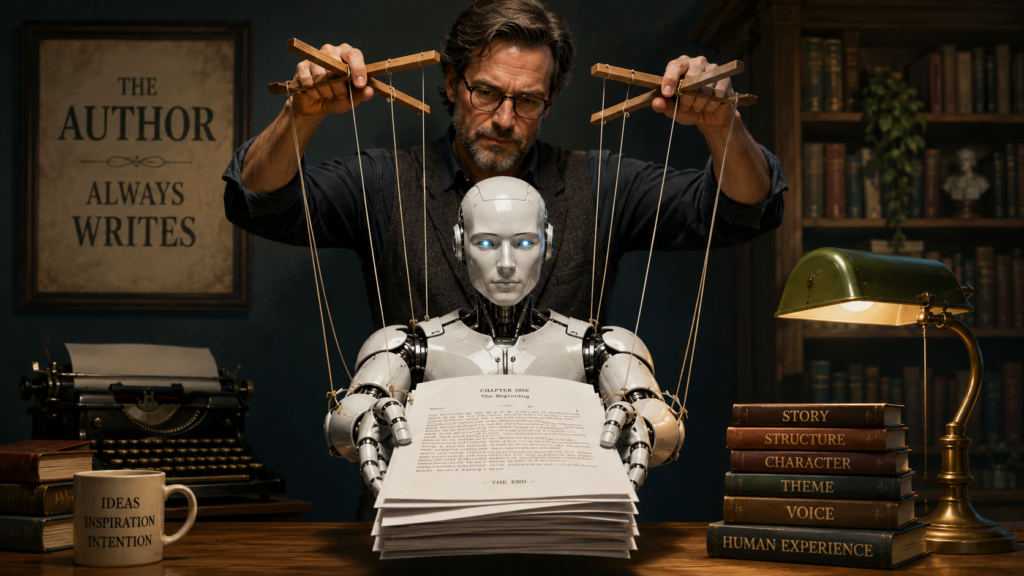
One of the primary challenges for a ghostwriter is how to turn the author client’s ideas, stories, and voice into a coherent narrative. Some time near the start of a ghostwriting project, the author and the ghostwriter work out a way that the author will communicate those ideas.
Common methods include:
- The author dictates ideas and recollections in audio recordings.
- The ghostwriter conducts a series of interviews with the author.
- The author assembles and shares source materials with ghostwriter.
- The author writes a rambling and randomly organized draft, which the ghostwriter uses as a starting point.
- The ghostwriter shadows author at events or meetings, then intuits concepts from those experiences.
But now that AI exists, there’s a new method: The author uses AI to shape their thoughts into a coherent narrative, then shares the AI-generated draft with the ghostwriter.
Pros and cons of the AI-generated author draft
From my experience with all of the above methods, I think an AI-generated draft has significant benefits, but major drawbacks as well.
On the plus side, an AI-generated draft tends to be far better organized than the randomly assembled collection of content that most authors share. The author has already done the work of identifying a narrative for the book and populating it with content. At least in theory, the ghostwriter’s job is no longer to write the book, but instead to rewrite the existing draft. You could even classify this an editing job, which is typically faster and less expensive than a writing job.
But as an editing job, it generates some unusual challenges:
- It may include hallucinated false information. Of course, author-supplied materials often include inaccuracies in any case, but an AI-generated draft needs particular attention. It should be the author’s job to identify and flag any false or dubious information in the draft, but I suspect that most author clients will lack the patience for such a close read.
- It may include other people’s ideas and content without attribution, which is a form of plagiarism. As with false information, this problem is not limited to AI; I once ghostwrote a book where the author’s source material included a number of unattributed ideas taken from others. (Once I discovered this, I restored appropriate credit for the ideas in the manuscript I wrote for the client.) But authors may not even know that their AI-generated draft includes other people’s ideas, creating unintended plagiarism that a ghostwriter would find tough to detect.
- It loses the author’s voice. Part of the ghostwriting process is the ghostwriter learning how the author likes to express themselves. Unless the author works very hard to infuse their voice into the AI-generated draft — which requires a lot of extra work with the AI tools — the draft will sound, not like the author, but like generic AI output. As a result, the ghostwriter needs to find other ways to identify the author’s voice, to avoid generating a manuscript that sounds more like an automaton than the author.
- It short-circuits discovery. Some of the best nuggets of insights and storytelling in ghostwritten material come from the ghostwriter interviewing the author — and noting unique and compelling details that the author didn’t even realize were worth keeping. An AI-generated draft is unlikely to highlight these goodies.
- The organization suggested by the AI may not be the best choice. Part of the ghostwriting process is analyzing the source material and deciding how best to tell the story it suggests. The structure of the AI-generated draft will likely follow typical nonfiction frameworks which the ghostwriter will then find tempting to adopt — even if the normal ghostwriting discovery process would have suggested something more interesting.
- The AI-generated text will require a complete rewrite. In addition to the ghostwriter’s usual work, they now must be certain to rewrite every sentence in the AI-generated draft — because any AI-generated material is not eligible for copyright. The ghostwriter must also be certain to remove AI “tells” like excessive em-dashes and the endless repetition of the construction “It’s not just xxx, it’s yyy.”
More efficient. Less creative. And lots of work.
From the author’s perspective, creating an AI-generated draft certainly seems more efficient than handing over collections of content or participating in endless interviews. And from the ghostwriter’s perspective, it has the benefit of delivering all the content in a neatly tied up package.
But turning that into a book is no normal editing job.
The ghostwriter is going to have to put in lots of additional work to turn the sanitized AI draft into something interesting enough to be worth reading. Basically, the ghostwriter needs to discover extra content left out of the draft while remedying the drawbacks of the AI-generated draft.
That’s still less work than a normal ghostwriting job. But it’s also less likely to generate a great book. The complete AI-generated draft will exert a gravitational pull, dragging the book into an uninteresting, generic hole that the ghostwriter must avoid.
If you hire a ghostwriter, should you use an AI draft to communicate with them? Perhaps. But you’ll need a ghostwriter that knows and can avoid the AI-generated pitfalls. And you’ll be paying nearly as much as if the ghostwriter used a more typical, non-AI-enhanced discovery process.