Navigating the continuum of publishing options
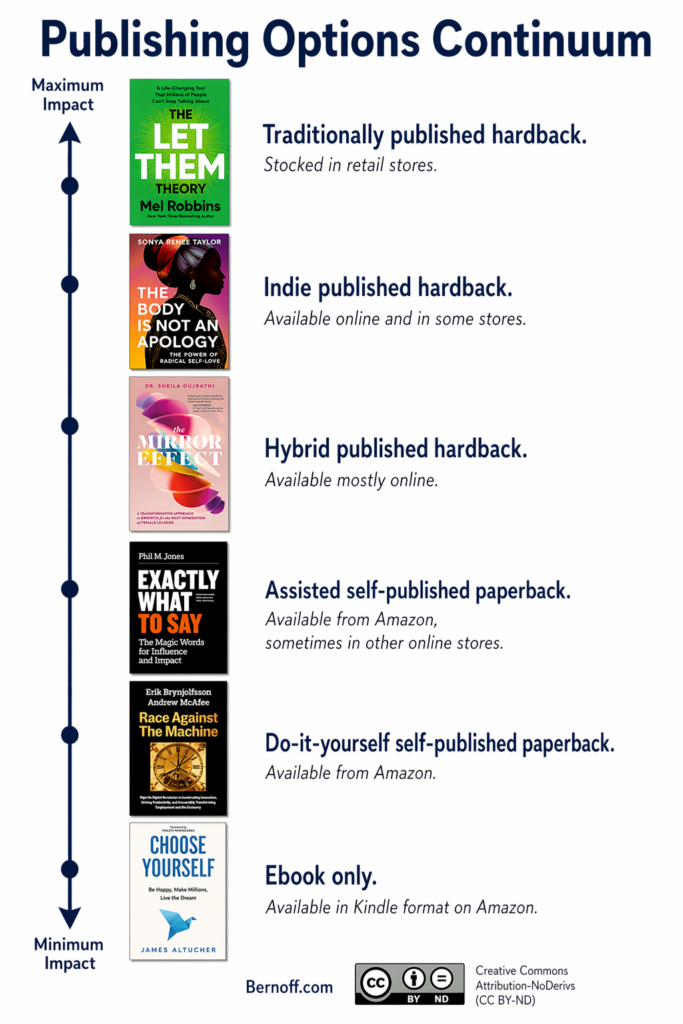
It’s easier than ever before to publish a book. But not all versions of “published” are equal.
So let’s run through the continuum of options available to you, how hard they are to get access to, and how likely they are to accomplish your goals. (In creating this chart, I’ve simplified things enormously — there are a lot of variations on these options — but especially for nonfiction authors, this set of possibilities is a good way to think about it.)
Pros and cons of different publishing options
Here are the alternatives, sorted from the most influential options (that are also the hardest to achieve) down to the easiest and least influential.
- Traditionally published hardback. This is what most people think of when they imagine themselves as a published author, with the imprint of a major publisher like Simon & Schuster, Wiley, or Harvard Business Press. To achieve this status, you must create an extensive book proposal that describes not only what the book will include but how you will successfully market it. Most publishers won’t even look at the proposal unless it comes from a well-known book agent, so you’ll need to find an agent and convince them you’re worth investing in. If you do succeed on this path, you’ll receive an advance payment and potentially be available in major bookstores. But not right away. It tends to take two years for traditionally published books to go from a signed deal to books on the shelf.
- Indie published hardback. There are plenty of smaller publishers that compete with the big guys, for example Berrett Kohler and Matt Holt. They typically demand the same sorts of proposals as the big publishers, but can pay smaller advances and offer less extensive distribution. As with the major houses, you can expect to wait two years for publication.
- Hybrid published hardback. If you want the same quality and similar distribution you get from traditional publishing but without having to deal with proposals and gatekeeping, check out hybrid publishers. These publishers can produce books with similar quality to any traditional publisher. The catch is, you’re going to have to pay them, typically at least $50,000 up front. (They also pay higher royalties, so if you sell enough, you’ll make that all back and more.) I’ve worked with a few that I can recommend: Amplify Publishing, Greenleaf, Ideapress, Page Two, and Morgan James. Damn Gravity is a smaller operation specializing in books for entrepreneurs, and my friend Phil Simon runs Racket Publishing. Unfortunately, there are plenty of operations that hold themselves out as hybrid publishers, but are just cranking out books of low quality, so beware if you go outside this list. Hybrids can get a book out in less than year, much faster than the traditional publishers.
- Assisted self-published paperback. While you need a publisher to get distribution, that’s not the only way to get published. Channels like Ingram Spark and Amazon’s Kindle Direct Publishing (which, despite its name, publishes print books as well as ebooks) enable you to get a book to readers without the need to go through a publishing company. They use print-on-demand technology, in which the book is printed only after the reader orders it, rather than having a stock of printed books in inventory. Because it can be tricky to manage tasks like editing, cover design, and Amazon listings properly, there are outfits that will help you get this path right, including Endeavor Ink and Gatekeeper Press. While it’s theoretically possible to do this for a hardback book, most people who take this route publish a paperback. Don’t expect bookstores to carry it (even if your publication partner says they can make it available, the stores aren’t likely to put it on the shelf). The best part of this path is that it’s cheap and fast — typically less than $10,000, with publication within six months. Books published this way rarely generate as much impact as those with traditional or hybrid publishers.
- Do-it-yourself self-published paperback. There’s nothing stopping you from going direct to Kindle Direct Publishing or Ingram Spark and listing your book on Amazon yourself. This is a common path for starting fiction writers, for example. But you’ll have to manage everything from cover design to copy editing on your own. If you see a crappy self-published book, they probably took this route. Even so, there are occasional breakout self-published successes like Eric Brynjolffson and Andrew McAfee’s Race Against the Machine.
- Ebook only. You can make things even simpler — just don’t publish a printed book at all. Upload your ebook to Amazon and you’re in business. Of course, an ebook-only publication is unlikely to gain much influence. (The most famous book that did was Fifty Shades of Grey.)
Balance your desire for influence and speed
The options at the bottom of my chart are far faster, but less likely to generate impact. You’ll have to shoulder all the burden of publicizing your book and making it pay off for you.
The more traditional options at the top of the chart carry a lot more prestige. Not coincidentally, they’re also the ones with the hardest hoops to jump through and the slowest path to publication. I’ve helped several authors succeed with these sorts of publishers recently, but don’t underestimate the challenges. Most book proposals get zero offers.
It’s worthwhile to consider these options well before you’re deep into the book creation process. Be aware of the tradeoffs, and you’ll maximize the chances of achieving your goals.