John Warner is right: human feedback is essential
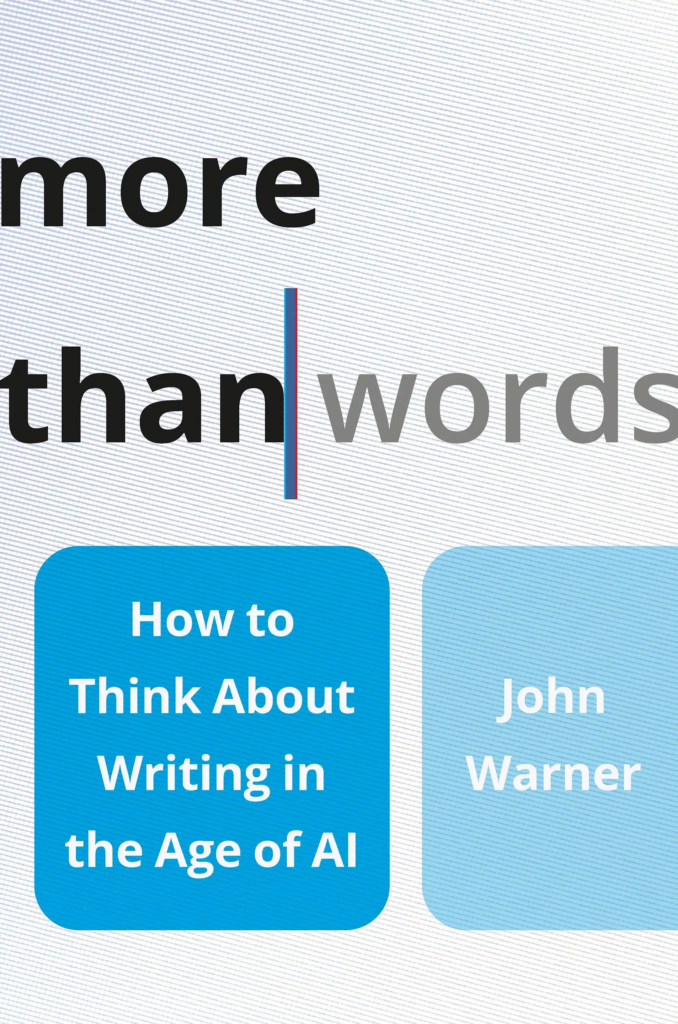
The writing teacher and author John Warner just posted an essential response to the questionable idea that LLMs can provide writing feedback that’s just as useful as comments from a human editor.
Here’s what prompted him to comment:
There is a study out of Stanford Law School that says in a blind evaluation, law professors preferred the feedback on student questions about contract law generated by a large language model over those written by other law professors.
As Warner points out, the purpose of writing feedback isn’t to judge writing, it’s to teach people how to be better writers — an essential human-to-human communications activity:
[LLMs] can be trained against rubrics to provide feedback that coaches students to improve outputs that will be graded against those rubrics. When it comes to the focus of my work – teaching writing – my objection to this feedback is that it is not particularly helpful feedback measured against the goal of helping students develop as writers. . . .
Over time, it became clear to me that this method of feedback [evaluation against a rubric], no matter how detailed or thorough, was not going to work to help students develop as writers. Mostly what I was engaged in was a kind of assessment theater meant to provide a justification for whatever grade I put on the assignment. I knew it wasn’t working because my students would show vanishingly little transfer of the deep concepts I thought I was trying to teach. On each assignment, I could coach them to a decent grade, but it was clear that a broader capacity to tackle writing problems independent of that coaching was not happening.
This tracks with my experience of editing books
As LLMs became more and more capable, I have certainly wondered if they could do the job I do as a developmental editor. After all, I worried, at some level all I am doing is comparing what I read against a mental model I have in my head of what a good book is like, identifying discrepancies, and correcting them. I think LLMs are poor and boring writers, but could they evolve into decent editors?
Unlike Warner, I’m not focused so much on teaching as on enabling a manuscript to shine and be effective in the best possible way.
Even so, I don’t think a machine can effectively do what I do.
It can certainly fix grammar, identify overuse of passive voice, find repetition, figure out where structure is weak, and so on.
But what it cannot do is figure out what is motivating the author to write, identify what makes the author unique, and suggest only those edits which would allow the author’s real intent to shine through. It might be able to figure out what’s wrong with a passage, but can it really identify the best way to fix it? If “best” means not just what makes the prose clearest but what expresses the author’s intent the most effectively, I think the answer is no.
This also illuminates why it is such a problem to edit AI-generated prose. The author’s intent is impossible to discover, because there is no author.
I hope that Warner and his believers continue to edit writers one-on-one, because it is the only way to make them better writers. No automated system can do that.
And maybe then by the time they get to me with their books, their sense of who they are as writers will be sufficiently well-developed that I can help them turn their manuscripts, not into perfect little arguments, but into persuasive and personal packages of human-infused meaning.