HubSpot screwed up. But then they backtracked and apologized.
Companies abuse their customers’ trust all the time. Sometimes they get caught. When they do, their apologies are usually defensive and hollow.
Not HubSpot. It behaved a lot better. But it still failed to fully acknowledge who it hurt and why.
What HubSpot did wrong
Last week, HubSpot attempted to enhance its service for all of its users. The goal was to tap into users’ information about contacts they were using HubSpot to email or reach out to. The idea was simple: if you learn information about a contact, like a new title or whether their email address was bouncing — that information should help all of HubSpot’s other users, too.
HubSpot opted all of its customers into this “enhancement.” This was the gist of the July 1 announcement:
On August 4, 2026, HubSpot is expanding its data discovery and intelligence features to bring more robust and reliable data to our customers. To power these tools, enrichment data such as business contact details, employer information, and email deliverability signals, may be shared with other customers.
As always, you have complete control over your settings. You can review or modify your Data Enrichment settings any time. To ensure your data is not collected and shared by HubSpot moving forward, you can opt out of your data being used for AI model training and stop using enrichment features before August 4. To turn off automatic enrichment, simply ensure your settings are ‘OFF.'”
But what seemed reasonable to HubSpot seemed outrageous to some of its customers. From their perspective, they had put large amounts of work into qualifying the customers and prospects they were reaching out to, and were outraged that by default, their work was being automatically shared with all the other customers who hadn’t done the work.
Here’s how one HubSpot user, Saarika Chotai, responded:
If you’re a business using HubSpot (or any CRM for that matter), this is your PSA to read the small print. As you’ll soon realise that “your data” has started becoming “our data” according to HubSpot.
But why this one frustrates the hell out of me… I’m responsible for growth at several B2B businesses, and we spend thousands of dollars every year on CRM licences, data enrichment tools and people whose job is to research, verify and maintain high quality contact data.
Our database isn’t just a list to us… it means so much more! We pride ourselves on the quality of our data and how we do it is our secret sauce. It takes a lot of work.
I feel it means the success of our campaigns over all the other B2B companies out there trying to do the same thing!
So when I read that our enrichment data may be shared with other customers unless you opt out, my immediate reaction was…WTF!
So we are now paying to build a database that also feeds their system and their revenue?
HubSpot’s apology almost hits the spot
I’ve analyzed plenty of apologies in this space. Most companies’ apologies are self-serving and defensive. A better apology needs to:
- Quickly acknowledge that it made a mistake.
- Explain why.
- Make it clear that they understand the damage they’d done.
- Undo the damage if possible.
- Explain how they have changed so they won’t make the mistake again.
Here’s how HubSpot’s Duncan Lenox, Chief Product and Technology Officer, explained that HubSpot was reversing its changes and apologized, with my commentary added.
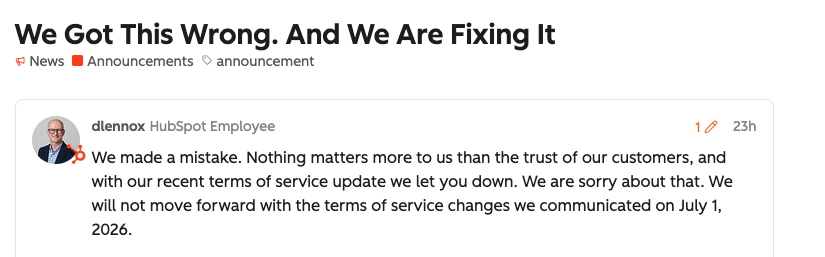
We Got This Wrong. And We Are Fixing It
We made a mistake. Nothing matters more to us than the trust of our customers, and with our recent terms of service update we let you down. We are sorry about that. We will not move forward with the terms of service changes we communicated on July 1, 2026.
You control your data. This has always been our policy and will not change. I want to explain what we were trying to do, where we went wrong, and how we’ll do better from here to earn and keep your trust.
HubSpot starts with an unequivocal statement that it made a mistake. It got quickly to the point and stated a principle that it violated: “You control your data.”
It explained how the decision got made:
What we were trying to do
We know how important prospecting is for customers who need to build pipeline. For a long time, much of the market has treated outbound as a volume game, using generic lists and spray-and-pray campaigns. That approach has never created the best experience for buyers, and it’s only become less effective as inboxes have gotten noisier.
We see an opportunity for a better vision, one that puts trust and relevance at the center of prospecting in the same way we did with inbound marketing. As this idea evolved, we called it Trusted Prospecting: helping you reach the right people, at the right time, with data and signals that make outreach feel timely and useful – not like spam.
In that context, a continuously refining dataset can play a role by improving accuracy, deliverability, and outcomes for everyone. That was the motivation behind our original announcement — to move prospecting in this more reliable, trusted direction for HubSpot customers.
To HubSpot, it seemed to make sense: cleaner more accurate and up-to-date data helps everyone. Who could object?
Where we went wrong
We did not meet the standard you expect from HubSpot when it comes to transparency. Even though our intent was to work with “business card–level” professional details in a shared enrichment dataset, the way we rolled this out made it feel like the relationship you have with your CRM (and with HubSpot) was changing underneath you. That’s on us and we are sorry.
We should have been clear about what we were proposing and how it would work. While we always intended for enrichment to remain strictly opt-in, we should have communicated better how that opt-in works, and importantly, how you as a customer could ensure you remain in control of that choice.
I also want to take this moment to clarify our commitment to customers that your CRM data – your contacts, notes, deals, call recordings, custom fields, and customer records – belongs to you. It should not be used without your permission, and never in ways you don’t expect.
Next, Lenox explains where the problem was. From HubSpot’s perspective, it was just collecting basic data. That “enrichment” was opt-out, even though in this description it says it was opt-in. True, only basic “business card-level” data was going to be shared. But the way it was rolled out surprised people and didn’t live up to the level of transparency that HubSpot owes its customers.
How we’ll do better from here
First, we will not move forward with the terms of service changes we announced on July 1.
On the product side, we are reassessing how to make opting into contact enrichment clearer, more easily governable, and simpler to manage.
We commit to you that when we introduce new enrichment capabilities that make use of your data, they will be fully and transparently opt‑in. You will have clear, upfront control over whether you participate and how your data is used in this context.
We still believe that there is a better, more effective way to prospect than the status quo. But we have to earn your trust as we build it together.
We’ll take the time to do this the right way, and we’ll communicate early, clearly, and across multiple channels before any future changes that affect your data.
Thank you for the feedback, the pushback, and the honesty. We can and will do better.
So the proposed change won’t happen, and HubSpot promises to be transparent and opt-in in the future.
What’s missing
Apology: check.
Acknowledgement of a lack of transparency: check.
Undo the damage: check.
Promise to be more thoughtful in the future: check.
What’s missing is this: acknowledgement that a lot of HubSpot’s customers put effort into maintaining and cleaning their databases of contacts, and that that labor can’t just be shared willy-nilly with everyone.
And the opt-in/opt-out confusion is significant. The July 1 announcement says HubSpot will allow users to opt out. But its apology says it will ask people in the future to opt in. These are not the same. HubSpot had the attitude that this was good for everybody, so it should be the default. A lot of its users disagreed.
HubSpot did better than most companies that screw up. But they still have a ways to go to truly understand why their customers were so upset by a change that seemed obvious to them.