Apparently, if you ask an AI model for a certain kind of ghostwriter, my name bubbles up. I’m starting to get leads as a result. I’ll show you how this worked for me and explain a bit about how I accidentally optimized myself for “GEO” (generative engine optimization), the discipline of getting yourself mentioned into AI search results.
What happens if you try to find a ghostwriter like me on AI?
To make sure the results I received were not influenced by my previous conversations with AI models, I used Google’s incognito mode. Where these models required a login, I used a fresh, never-before-used Gmail account.
Here’s the prompt I used:
Create a list of ten ghostwriters appropriate for a project I am working on. The candidate must be familiar with analyzing technology trends, experienced at ghostwriting, comfortable with AI (but does not use it for writing), and knowledgeable about how business books can enhance my reputation as a thought leader. They should also be good at helping me flesh out a big idea.
I constructed this query carefully to match the kind of books I work on: business books about tech trends and big ideas. An author looking to write a memoir wouldn’t select me, nor would an author writing a psychology self-help book. But I would want to be considered by someone who wrote a prompt like the one I crafted.
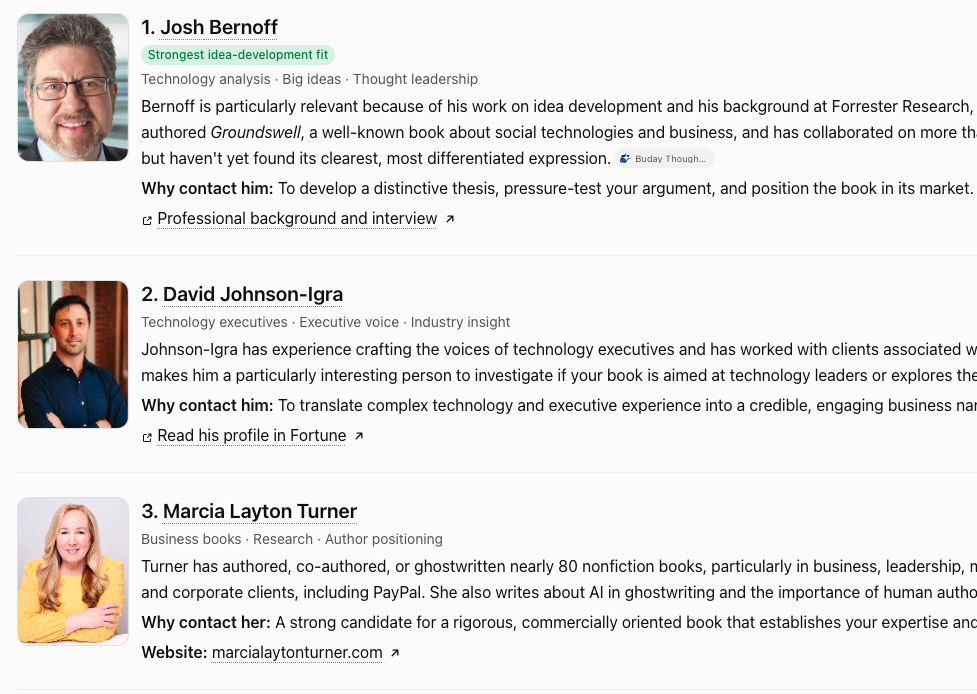
ChatGPT ranked me first. Here’s the start of its response:
10 ghostwriters to consider for your technology-focused business book
For your project, I would look for more than an experienced writer. You need a thought-partner who can help discover, challenge, and sharpen your big idea, connect it to technology trends, and turn it into a book that strengthens your reputation as a thought leader.
I’d prioritize five capabilities:
Technology fluency: Can interpret emerging technologies and their business implications, not merely summarize trends.
Big-idea development: Can uncover your distinctive point of view, build a compelling thesis, and develop original frameworks.
Proven ghostwriting experience: Can capture your voice and turn interviews, experience, and expertise into a cohesive manuscript.
Human-written work: Understands AI and its implications but agrees not to use generative AI to draft or write your manuscript.
Thought-leadership strategy: Understands how a book can build authority, generate speaking opportunities, support consulting or advisory work, and differentiate you from competitors.
That last distinction matters: a book designed to build authority needs a recognizable point of view, not just good prose. The Association of Ghostwriters discusses the growing importance of human authorship and AI policies in the profession, while specialist book strategists emphasize positioning and idea development before writing begins.
The shortlist
These are ten people or specialist teams worth investigating. I’ve weighted the list toward people with evidence of business-book development, technology or innovation expertise, executive ghostwriting, or thought-leadership strategy.
One important caveat: I could not independently verify that all ten categorically refuse to use AI for writing. I’ve distinguished documented experience from fit hypotheses, so you can use this as a credible starting list rather than a claim that every candidate already meets every requirement.
1. Josh Bernoff
Strongest idea-development fit
Technology analysis · Big ideas · Thought leadership
Bernoff is particularly relevant because of his work on idea development and his background at Forrester Research, where he studied technology-driven business transformation. He co-authored Groundswell, a well-known book about social technologies and business, and has collaborated on more than 50 books. He could be especially valuable if you have a promising idea but haven’t yet found its clearest, most differentiated expression.
The list continued with David Johnson-Igra, Marcia Layton Turner, and Mary Rose Maguire. Marcia, the founder of the Association of Ghostwriters, is a friend.
Claude also listed me first. Its answer:
Here are ten candidates, with how each fits your criteria. I could not verify any individual’s personal policy on using AI to write, so please ask each one directly and get the answer in the contract. That matters most for anyone who says they use AI “selectively.”
Individual ghostwriters
Josh Bernoff. He is the strongest overall match. He spent 20 years at Forrester analyzing technology and business, and he works with nonfiction authors as an advisor, coach, editor, or ghostwriter. He presents himself as an expert on how business books can propel thinkers to prominence. His site also says he partnered with Soqratic on an AI-powered coach built from his books and blog, which shows he is comfortable with AI. about me +2
Shel Israel. He spent more than 20 years as a tech industry PR business writer, wrote six books about disruptive technologies for business readers, and now ghostwrites, rewrites, and edits business books, with a focus on demonstrating thought leadership. He is a good fit if your project leans on technology trends. reedsy
Gregory Mone. He is a science writer and former Popular Science columnist who has collaborated with Bill Nye, Neil deGrasse Tyson, and MIT AI expert Daniela Rus. He co-wrote The Heart and the Chip with Rus, on robots and AI. He is strongest at making complex tech ideas accessible and shaping them into a book. He is less of a classic executive-thought-leadership specialist. Substackabramsbooks
Ian Phillipson. He has specialized in ghostwriting books for 15 years, and his authors work mainly in technology, finance, and business leadership, with topics including AI, IoT, and cybersecurity. He helps authors who struggle to get ideas out of their heads and shape them into a narrative. reedsyreedsy
Michelle Rafter. She is a former business and technology journalist who now ghostwrites thought leadership for CEOs and large management consulting firms, and has ghostwritten two books since 2021. Her listed subjects include AI for business, digital transformation, and the future of work. She is a good fit for research-driven, survey-based ideas. asja
. . . .
This list is interesting. Shel was a close friend and a good writer, but he died last year. I’ve interacted with Gregory and Michelle is a great resource as well. Small world, I suppose.
What about other AI tools? Perplexity said “I can’t responsibly name ten candidates who meet all of those criteria based on the available information.” I was not on Google’s list, which included the writers Nicolas Cole and Derek Lewis and my friend Alice Sullivan. (Alice is a great ghostwriter, but I bet if you asked her she’d tell you I was a better choice for a tech trends book.) Grok left me off the list and listed writers including Richard Lowe, Alexander Lewis, Barry Fox/Nadine Taylor, and Marcia Layton Turner (again). Meta AI also didn’t suggest me, but suggested Emily Crookston, Laura Sherman, Barry Fox/Nadine Taylor, and Dan Gerstein, who owns the ghostwriting agency Gotham Ghostwriters but is not a ghostwriter himself.
Why I ranked for some of these AI search tools
This set of searches is particularly interesting because ghostwriters are, by their nature, not particularly visible. The best ones spend most of their time with clients and writing. Ghosts shouldn’t allow their work with clients to be used to train AI tools, so most of their activity doesn’t contribute to how AI sees them.
Coordinate messaging across ad campaigns to reinforce authority signals.
Other sources generally agree. And this explains how I got to the top of those lists. My posts on this blog and LinkedIn often answer questions and I always put the answer in the lede at the top of the post. I use headings. I link to sources. I like bullets and lists. Although I don’t have ad campaigns, my posts follow the first four principles already.
I’m trying to serve readers with quick, easily parsed answers. AI is reading the signals I created for you, not for it. In SEO, sometimes the principles for searchability were misaligned with the best practices for readability — for example, SEO can be influenced by stuffing your post with keywords. But because AI reads text more like people do, good writing practices often boost GEO searchability.
I’m sure it also helps that I post every weekday. The combined weight of my content means that AI perceives me as helpful and authoritative. I do this because I like to write, but it has now paid off in lead generation.
Simply put, good content marketing principles are best practices for the AI era.
Observations from the LLMs’ choices
Am I the best ghostwriting choice for these types of books? I’ve only ghostwritten four books so far. As much as I’d like to believe I am a great choice, it’s likely that there are people better than me. It appears that ChatGPT and Claude have selected me for these lists because I am a highly visible writer who answers a lot of questions, not because I am the best ghostwriter.
Google, Grok, and Meta AI appear to be influenced more by people whose sites identify them as ghostwriters (mine doesn’t emphasize that so much). But the fact that they all have such different lists fascinates me. The methods that Large Language Models use to find answers are far from standardized, and always changing. If you run this same query a month from now, you could get completely different answers.
That said, whatever you do, it helps to be visible and helpful, and to write in a way that straightforwardly answers your audience’s questions. And link to those you admire. That’s one way to become a solid resource with a good reputation. It takes time — I’ve spent more than a decade on it. But it’s emotionally rewarding and now, apparently, financially rewarding as well.