Forrester forever
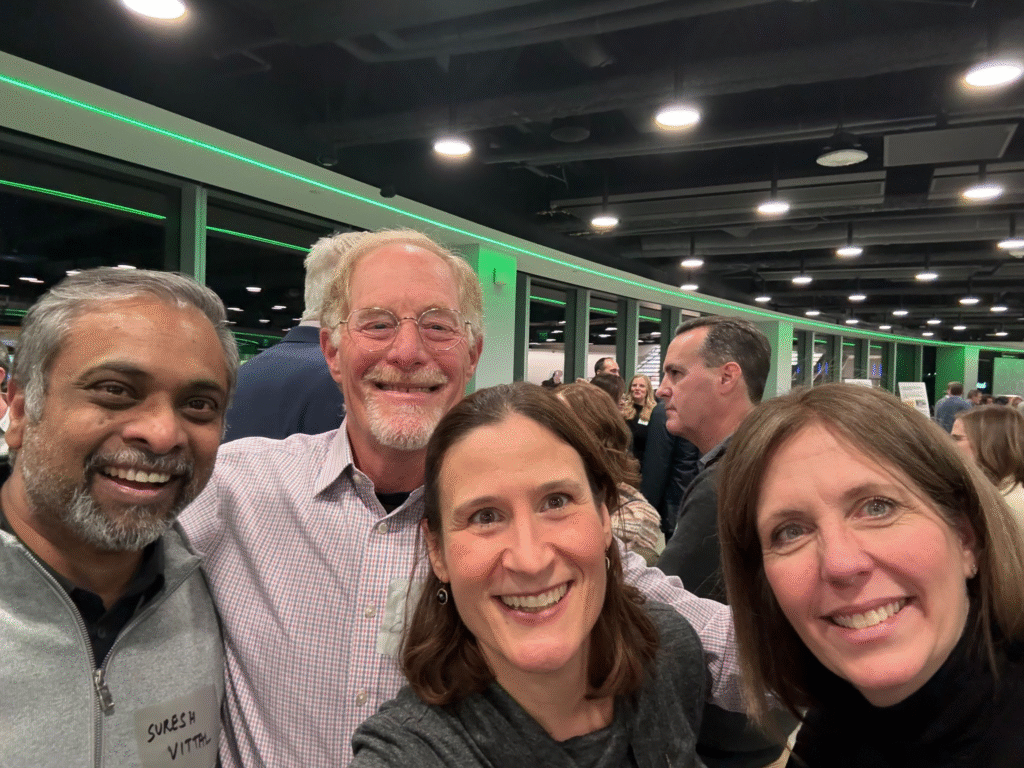
Ten years after leaving Forrester Research, I got a chance to reflect on what it did for my career at the Forrester reunion, which took place yesterday evening.
The reunion took place in Boston and was organized by several Forrester alumni who left the company years ago. George Colony, Forrester founder and CEO, also participated.
About 150 people attended. Most came from the Boston area, where Forrester has its main office, but some people also flew in from as far away as California. I drive two hours from Maine to get there.
What made Forrester special
Ostensibly, Forrester is in the business of helping executives to make smarter decisions in a world transformed by constant technology change.
But over the 20 years that I spent there (1995-2015) and the ten years since, it’s become clear to me that something deeper was going on.
This was a place full of the smartest people I ever encountered. They were also the most generous smart people you’ll ever meet.
Technology shifts — whether we’re talking ecommerce, cloud, social media, AI, the list is endless — challenge people. They also create opportunity. But the most salient quality of technology shifts is that they are new, startling, unpredictable, and potentially far-reaching. This creates an environment in which it’s possible to conceive and share new ideas that will profoundly affect markets and the world.
Forrester is dedicated to the discovery and refinement of those ideas and exploring their consequences.
To do that requires a unique mindset and culture:
- A constant quest for knowledge. There is a reason the company was originally called “Forrester Research.” Research includes talking with people throughout industry, taking hundreds of briefings from both startups and established companies, conducting surveys, and endless, boundless curiosity. Any pundit can make predictions, Substack is full of them. But at Forrester, for any prediction you made, you needed evidence to back it up. Because change is constant, that’s a continuous quest; whatever you thought you knew three months ago, it’s rapidly becoming obsolete.
- A bias for boldness. Forrester’s tagline is “Bold at work.” You don’t get far there by predicting what everyone else has already said. There is always a need for a new formulation, a new spin, or a counterintuitive take on what’s happening. It’s an incubator for creativity. Whatever creative impulses you have, it is going to supercharge them. But this isn’t boldness for the sake of shock value. Your thesis has to be based on research.
- A collaborative culture. Analysts get help from research directors or editors, who have more experience in making ideas powerful and effective. They get support from junior staffers known as “research associates” who, after a few years, may graduate to become analysts themselves. There are various folks who help with client relationships, especially including a hard-working and supportive sales force. And if you’re working on an idea and you need help from an expert in another area, the analyst who’s expert in that is usually happy to explain, say, how large language models work, the mechanics of cloud infrastructure, how media companies are structured, or how innovation works in India. The analyst is the star, but they’re never really alone.
- Integrity. Forrester publishes what analysts see as the truth. They may be wrong, but they cannot be bought. The dedication to unbiased research is ironclad. I’ve seen them lose six-figure deals by insisting on that integrity, which is essential to maintaining the company’s reputation.
- A dedication to powerful writing. Forrester delivers its insights through reports, which are brief, powerful, clearly written documents explaining new ideas or analyzing market developments. The report writing and editing process is relentless. Reports often go through dozens of drafts. The editor’s job is to help the analyst write in a more pointed, briefer, and more original way, to effectively cite evidence and research, and to relentlessly focus not just on the ideas but on their consequences for the industry they serve. I was a good writer when I joined Forrester. I became a great writer — and author — in my time there. I also edited some of the company’s most influential reports. It is not an exaggeration to say that most of the ideas in my book Writing Without Bullshit came from my Forrester experience.
Culture and people
Last night, George Colony told us that the culture of Forrester came, not from him, but from all of us. He deserves more credit than that. But it’s true, the analysts and everyone else who worked there embraced, extended, and shared his vision.
Being part of something like that is a special experience. That’s why it was so much fun to see the people with whom I’d shared it last night. Most of them had gone on to other careers after years at Forrester: founding startups, managing large organizations, joining competitors, or becoming independent thought leaders. But just one look at somebody like Henry Harteveldt, still the most influential travel analyst in the world, or Karyl Levinson, the amazingly talented former head of Forrester PR, or Baba Shetty, who has led both media organizations and advertising agencies, brought it all back.
We struggled together. We struggled with ideas. We struggled with challenging clients. We struggled with impossible travel schedules and attacks from critics. Our ideas made a difference in the world. And then we did it again, and again. In that room in Boston were a lot of people who I’d struggled with, and ten years after I left, we were mostly a little greyer and fatter with less hair, but it all came rushing back. I don’t remember ever hugging so many people at one event.
A personal appreciation
I joined Forrester expecting to spend a few years and make contacts that would lead to my next job. I never expected to spend 20 years there.
I left in 2015 at age 57. Everything I have accomplished since then is rooted in my experience at Forrester.
I’ve already talked about the discipline of writing. I also learned to blog there, with encouragement from fellow analyst Charlene Li. I learned to love blogging, and that’s why I’m able to contribute to this blog every weekday without my enthusiasm flagging.
George gave Charlene and me the opportunity to write Groundswell, which became a bestseller. Forrester had published one book previously, which had not been an overwhelming success, but George had faith in us. The three books I cowrote there and the two I edited were the launch point for my career as an author, which had been a lifelong dream.
About one-third of the clients I work with now are former Forrester analysts writing books. Analysts make great authors: they already know how organize ideas and how to write powerfully, and they’re experts in areas of rapid change and great interest. I recently helped a former analyst write a proposal that got picked up by my former editor at a publishing house. I’m coaching another right now, and am likely to be working with a third soon. Sometimes these are people whose experience at Forrester didn’t overlap with mine, but they know people who know me, and more importantly, we know our shared experience is going to sync up.
Even the clients who weren’t former analysts are there because of my experience at Forrester. They were referred by my former colleagues, or they’re just impressed by my experience. There are very few ghostwriters and editors who used to be technology analysts, which means I tend to get recommended for elite projects that support a level of compensation that maintains my lifestyle.
I learned to have a blast creating and writing about ideas at Forrester. I still get to do that. I could not have had a better entrée into the career I have now.
And I am sure that many of the other faces I saw yesterday would say the same.
I’m old now. But many of you reading this are not. If you get a chance to be part of a place like Forrester in your career, take it. It could make all the difference in building a career that matters, among people who are as passionate about the things you care about as you are.
I share the same sentiment, Josh. I cherished my time at Forrester. It was my first 3 years of my career and it gave me a broad perspective of the telecom industry which I had a chance to grow in. The culture and values of Forrester (which you outlined above perfectly) shaped the principles by which I operated everyday after moving to Comcast for 23 years. I wish I knew about the reunion, I would have been there. I will keep an eye out for the next one. I hope you are doing well!
Josh, love this article.
Thank you for sharing a fascinating insight into Forrester and what made it special. I have found that a few companies at any given time have that special DNA, the secret sauce of outstanding people and culture. Those people create outstanding work in an exciting way that inspires more greatness. I believe that is what propels progress in our world.
Surely Forrester’s magic didn’t emerge overnight but rather was the result of that collective shaping that George Colony spoke of. Indeed, all great things come through extraordinary collective vision and effort. This reminds me of my favorite quote on leadership by Jim Kouzes and Barry Posner, authors of The Leadership Challenge (now in 7th or 8th edition after 40+ years):
“Leadership is art of mobilizing others to want to struggle for shared aspirations”
May your story inspire hope and mobilize young people and others to come together and build future great organizations like Forrester.