Are you the author of your AI-assisted work?
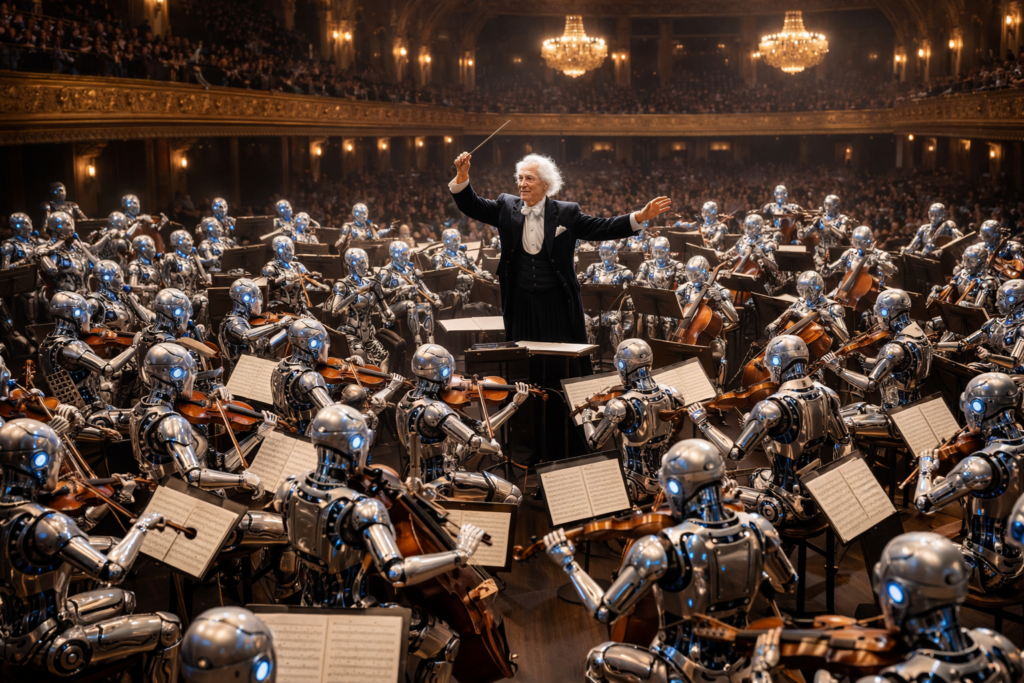
Think for a minute about the creative work you do. Which of these categories best describes your creative work?
- Hand-crafter: I do most of the detailed work by hand, rarely delegating to automated tools.
- Tool exploiter: I use automated tools to speed some elements of the work, but I’m deeply involved with how those tools are used and with modifying the results they create.
- Automation orchestrator: I generate most of the work I do with automated tools; my only real job is to manage those tools and make them work better for me.
With these categories in mind, let’s consider two questions: are you the author of your work, and are you growing and learning?
Are you the author of your work?
Who deserves the byline on what you create?
Clearly, if you’re a hand-crafter, you do. This applies regardless of whether you’re coding, writing, or making graphical art. You made it yourself.
But if you’re a tool exploiter, you still deserve that same byline. No one is going to deny your creative work as a writer if you used automated interview transcription tools or grammar checking. Even if you brainstormed the structure of your story with Claude, you were the one who decided what to do with the suggestions it made.
If you’re orchestrating automated output, even if you polish it a little, you don’t deserve credit. “I set up a tool and published what it created” is not equal to “I created this thing.” What you are doing may be valuable, but it is not authorship.
Are you learning and growing?
Hand-crafters learn and grow. So do tool exploiters. Automation orchestrators don’t learn to be better creative workers.
This relates to what I call the “in up to your elbows” effect. A writer who is constantly using tools, evaluating their output, recombining it, and shaping it is learning the craft of writing. When you look at what an LLM drafts and say “Wait, that isn’t working” and then try to evaluate why it isn’t working, you are learning about language and story and craft. I’d argue the same applies if you’re an architect or a software engineer using and modifying the results generated by automated tools.
The process of creating — with or without the help of tools — and then revising is how we learn and grow as creative contributors. It’s even better with the help of expert coaches like editors. AI needn’t displace that. In fact, understanding the shortfalls of AI tools is part of that learning process.
This isn’t completely new. The wood artist needs to learn how the lathe works and how to use it. The coder needs to understand the best ways to use an integrated development environment with debugging tools. The writer needs to learn the ins and outs of Microsoft Word. In the same way, a creative worker needs to learn what AI does well and what it needs help with.
On the other hand, the automation orchestrator is not learning and growing. Their interactions with the work are on a surface level, they are not in up to their elbows. This is the challenge with writers in university using AI to complete assignments — they are losing the opportunity to learn. But the problem doesn’t stop in school. If AI is doing the creative work, you aren’t, and you’re not getting any smarter about it.
Efficiency is fine. Replacement isn’t. At least it isn’t if you expect to be growing as a creative person.
Thank you for noting the subtleties of using AI to improve, not substitute for, intelligent use of available tools. Charlene’s book arrived today – masterful.
In a networking meeting yesterday, made up of writers and editors, an interesting collection of nutshell descriptions of what AI is and isn’t amassed. One or two of these I gleaned from your posts on the subject.
AI has no wit. (credits to Josh Bernoff)
AI has no soul.
AI has no discernment. (You have said this in so many words, too, as well as others.)
AI has no awareness, nor self-awareness.
AI cannot make analogies, relationships between things that do not appear related.
Dealing with AI is like dealing with an Alzheimer’s patient – connection and continuity suffer constant gaps, both internally and externally.
It is not the be-all-and-end-all. It is a tool, not our next Shiny Object. We are not crows. (Although our obsession with AI may prove the superior intelligence of crows.)