AI as writing coach; Booktok deception; state of publishing webinar: Newsletter 16 September 2026
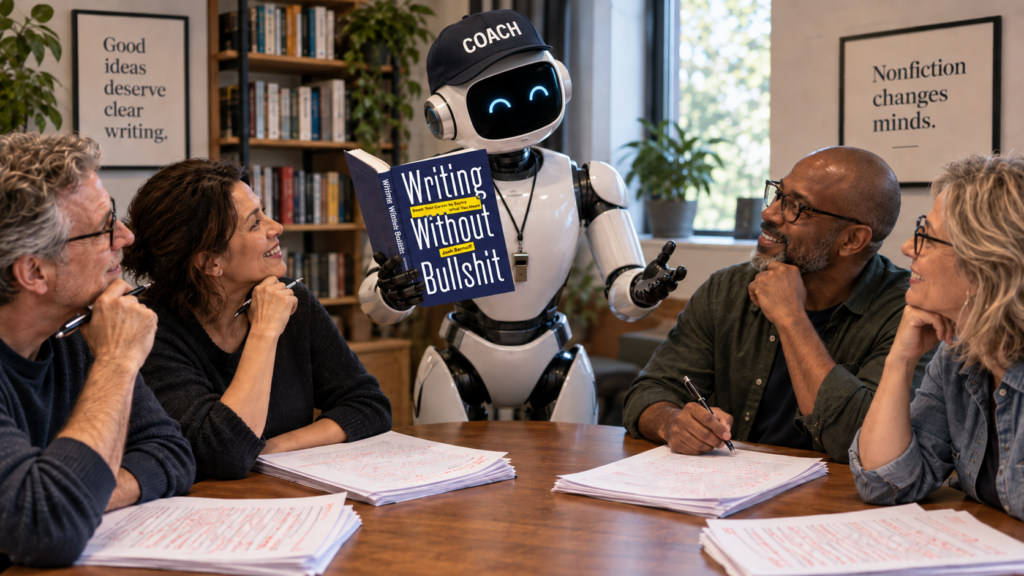
Newsletter 168. You can tap AI to help you write better — without bullsh*t. Plus, the AI doom talk could just be hype, a publisher that fails to market half its books, three people to follow and three books to read.
Can AI help you write better?
We all know AI is a terrible writer. Well, more accurately, it’s a boring writer with an number of annoying tells.
But if you take the time to write a piece, an LLM like Claude or ChatGPT can help you figure out some ways you could be better.
Here’s a list of writing principles from my book Writing Without Bullsh*t along with ways you can use Large Language Models to adopt them more thoughtfully. Upload a piece you wrote, then do the following:
- Write short. Brief is better. Ask an LLM to edit what you wrote, reducing the word count by 25%, and to explain what it has deleted. Do you agree with the deletions? How were you repeating yourself? Next time, see if you can self-edit your prose to be shorter.
- Front-load your writing. Ask an LLM to create a title and a one- or two-sentence opening for what you wrote. Do you like the title and lead it wrote? How would you do it differently? Could you write a title or a lead that’s more engaging? Next time create your own and compare.
- Purge passive voice. Read what you wrote and mark the passive voice sentences (use the zombies test). Now ask the LLM to identify them and suggest active voice rewrites. Did you find the same sentences as the AI? How would you rewrite them?
- Replace jargon. Ask the LLM to find jargon words — specialized words that would be unfamiliar to most of your readers. You can also ask your LLM for definitions for those words. Do you agree with the LLM’s definition, or would you define them differently? How could you rewrite what you wrote to avoid the jargon, or include a definition that clears up the meaning?
- Eliminate weasel words. Weasel words are vague qualifiers and intensifiers like very, huge, many, or sometimes. They read as deceptive. You can often just eliminate them, or replace them with something more precise. Ask your LLM to review this post about weasel words, then identify the weasel words in what you wrote. Could you delete them without changing the meaning? Do you agree that fixing them makes your prose more forceful?
- Be direct. Often, the simplest way to make a passage read more directly is to use the word “you” and commands to tell the reader what you want them to do. Use an LLM to identify the passages in your writing that are advice, and suggest a way to rewrite them with the word “you,” or as a command. Are you uncomfortable with these rewrites? How would you make the same kind of change?
- Reveal structure. It’s easier for readers to understand what you wrote if you include structural elements like titles, subheads, bulleted lists, and graphics. Ask an LLM to include subheads in what you wrote. Do you agree with how it broke things down, or would you organize it differently? Request that it add a bulleted list to replace some of what you wrote — do you agree that the list is better, or not? Finally, ask it to create an illustration that elucidates the meaning of your passage. Is the resulting graphic actually helpful? If you were working with a graphic designer, how would you tell them to illustrate the same concept?
- Be personal. AI is bad at human connections. No matter what kind of writer you are, that’s one strength you have that it can never match. Where could you insert a personal comment or describe a personal experience that would make what you wrote more relatable?
A word to the wise: all LLM’s have a switch that prevents them from using your text for training purposes. If you don’t want an LLM to steal your content as you use it to improve your writing, flip that switch before using it.
Even if you agree with me that LLMs are poor writers, they can deliver a different perspective without ever tiring or becoming annoyed. You can learn from them, even if what you learn is how to tap into your own writing talents. Asking an LLM to write for you is lazy and unfair to readers. But asking one to find where your writing could be improved is helpful and leaves you in charge. That’s how to become smarter about writing every time you write something.
News for writers and other who think
Have you been putting off taking the AI and the Writing Profession survey? Join the 700 people who’ve weighed in so far. It’s 15 minutes, and the results will help create actual data to inform publishers, regulators, and writing teachers how real writers are using AI or not, and how they feel about it. Take it here.
Here’s a summary of how some smart authors are using AI to write more efficiently — without making it actually write the book.
Jane Friedman suggests how writing conference planners should include AI in their programs. I’m helping to plan a conference right now — and we’re trying to balance a session of “How to use AI” type advice without allowing it to take over the whole event.
Speaking of Jane, she’s hosting a free “State of Publishing” webinar Friday. Every author should probably tune in to this one.
Booktok (TikTok book promotion) sounds like fun . . . until you realize that the books that really take off are often engineered campaigns by paid Booktok influencers.
The CEOs of the big AI companies are begging to be regulated to make sure their AI’s don’t kill everyone on the planet. But could it all be a self-serving ploy? (Wired link, registration required)
Half of the books at this publishing imprint got no marketing budget at all. Sadly, this is typical.
Three people to follow
Brian Chesky , CEO, Airbnb
Erika Clegg DL FRSA , author of a revealing book on corporate culture, Junk Values
James Governor , cofounder of the analyst firm RedMonk
Three books to read
A Technique for Producing Ideas by Professor James Young (McGraw Hill, 2003). Sneaky, skinny classic on how to unleash your creativity.
Leading with Creativity Without Losing Your Mind: Messy Lessons in Creative Leadership by Peter Allinson (Apress, 2026). Leadership and creativity need not be at odds.
Mothers of Invention: A History of Creativity from the Greek Muses by Moiya McTier (Grand Central, 2026). An innovative illustrated history of ideas.