The road to hell is paved with false productivity
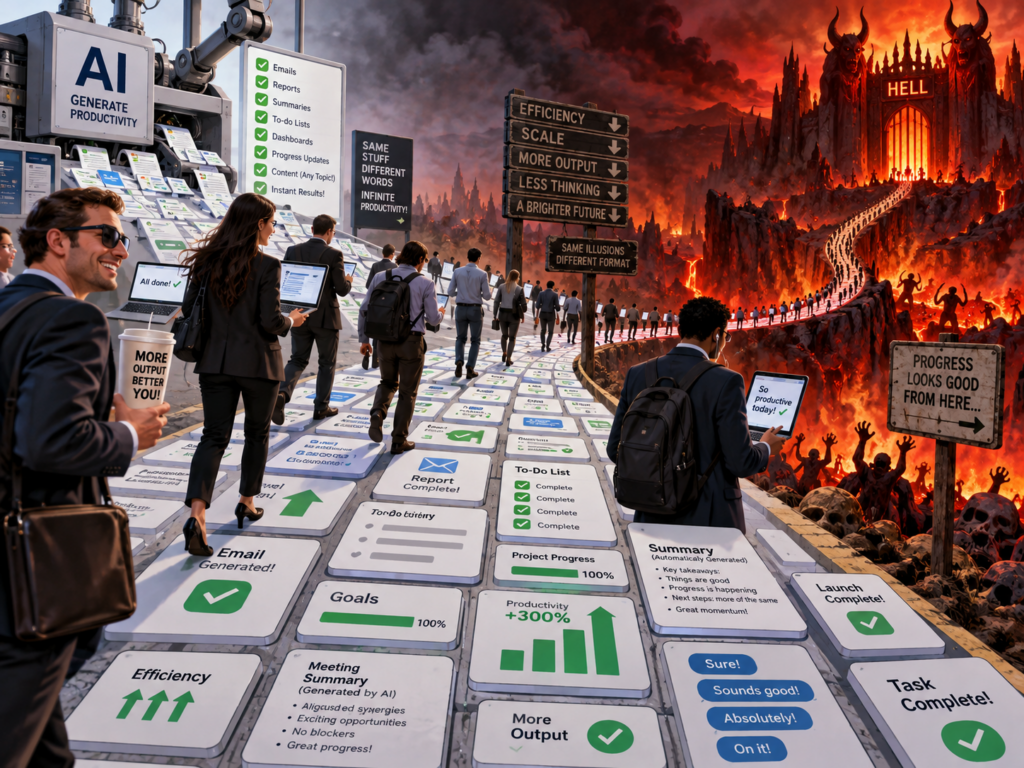
One principle is at the center of all debates about AI use: That AI makes workers more productive
AI makes workers more productive.
But what does productive mean?
Based on my experience working with many people who’ve adopted AI in their work — as well as the results of last year’s AI and the Writing Profession Study — productive can mean one of two things:
- Improving how much you produce, often at lower quality.
- Improving the quality of what you produce.
If you use AI to produce more, crappier stuff, you’re making the world worse.
If you use AI to produce better stuff, you’re making the world better.
And that is the one choice that makes all the difference.
The problem with more, crappier stuff
We’ve been trained that more, crappier stuff is good. This, after all, is the concept behind Clayton Christensen’s concept of disruption. A new entrant finds a way to make something far more cheaply, but with fewer features. People embrace the new thing. The original dinosaur companies can’t compete and go out of business.
Of course, the problem with this is we end up with crappy experiences. And AI is great at creating crappy experiences.
It will generate two dozen emails for you, all customized, all soulless, and all lacking the key piece of information that the recipient actually needs.
It will write that report for you without truly understanding what is important to the company or the market.
It will write the code quickly without knowledge of how it messes up the rest of the company’s software or violates the user’s privacy.
It will write a barely coherent book from the source material in a day instead of spending months on drafts and interviews.
If you’re compensated on quantity of stuff created, you win. AI can drive that metric skyward. Your productivity looks fantastic.
But you’ve now created a huge challenge challenge for the people consuming what you created. They’ll find the book vacuous, the code buggy, the report impenetrable, and the emails irrelevant. Less work for you means more work for them. You’ve increased your imaginary “productivity” at the expense of their (actual) productivity.
The benefit of creating better stuff
AI in the hands of a skilled practitioner can make things much better.
It can evaluate five alternative outreach emails you wrote and tell you what parts of each one are most likely to succeed. You may not trust it, but it will help you think.
It can turn the data in that report into beautiful graphics and compare the report with other reports to tell you where you could make it better. If you ask it, it will also tell you where your argument has weaknesses and needs more information — and even help you find sources to back up your arguments.
It can evaluate different coding approaches according to a variety of metrics that matter to the company so you can carefully optimize that code in your actual work environment.
And it you’re writing a book, it can find sources, analyze material you’ve assembled, vet what you wrote, find redundancies, improve consistency, and make suggestions you may not have considered. It’s not a substitute for a skilled editor. It’s a tireless researcher and 100 unskilled beta readers rolled into one. Smart writers find dozens of ways to use AI to make their work better.
What this means for managers and consumers
Any metric based on quantity is now suspect. AI will help people blow through it by creating vast quantities of slop.
Managers and executives must cease to measure work and instead incent the creation of quality. They should stop asking “Can we do the same with fewer people” — because those people will be reduced from creative producers to slop-monitors. Their customers will notice the decline in quality.
Instead, they should ask “How can AI make our people smarter and improve quality?” That will not only maintain worker morale but boost customer loyalty.
As consumers, we also need to push back. We need to ways to report feckless tech support chatbots, inadequate product quality, slop-laden outreach, and inhuman crappiness. I’d love to see a slop index for every company on the planet. If you’re building SlopYelp, I’ll be cheering you on.
The problem is not AI. It is how people use it — and more importantly, how they are incented to use it.
If AI makes your work better, I salute you.
If it makes your work faster, please rethink what you’re doing. The road to hell is paved with false productivity.