The free answer to every imaginable question about writing, books, and publishing
A while back, I found a partner to help me turn my millions of words of blog posts and book chapters about writing and publishing into an answer machine. That partner was Soqratic (yes, I helped come up with the name). The result was a pretty effective little virtual coach you could subscribe to for those answers.
But we made an error. I assumed that lots of people would pay for access to that chatbot: $1.99 for the first two weeks, $17.95 a week after that. While many prospective authors want answers about books and publishing, they aren’t necessarily willing to pay for it, even at those very low prices. A smattering of folks tried it out — one actually used it for a period of months to prepare her book and approach publishers — but it was far from a runaway success.
So we pivoted. The virtual coach is now free.
Your free virtual book coach
The coach is now improved, giving more effective answers and clearer links to the sources from which it gets the information (which are all content written by me — this is not just “ChatGPT for authors”). Soqratic has continued to make it better. And we’ve changed the business model: You can now try it out without the need to enter payment information.
Here is a sample questions and the coach’s response:
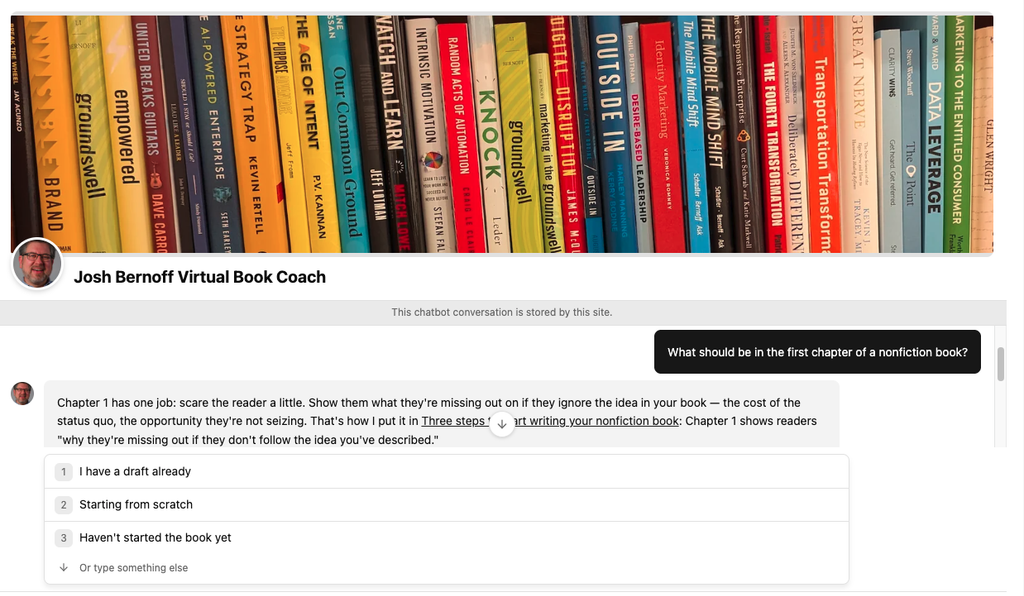
Q: What should be in the first chapter of a nonfiction book?
A: Chapter 1 has one job: scare the reader a little. Show them what they’re missing out on if they ignore the idea in your book, the opportunity they’re not seizing. That how I put it in Three steps to start writing your nonfiction book: Chapter 1 shows readers “‘why they’re missing out if they don’t follow the idea you’ve described.
Practically, that means:
- A story that puts the reader’s problem in sharp relief — not your own origin story, theirs.
- The stakes of ignoring the problem.
- Your core idea, stated plainly, with a promise of what the book will show them how to do.
Don’t lead with throat-clearing — credentials, an outline of what’s to come, a history of the topic. As I put it in Nonfiction writers: Start every chapter with a story, when I edit a chapter, “I look for the stories. . . I just delete everything before the first story.” Chapter 1 is no exception. One note: write it least. It’s easiest to write once you’ve draftede a few other chapters and know exactly what idea you’re setting up.
Where are you in the process — do you have a draft of Chapter 1 already, or are you starting from scratch?
- I have a draft already
- Starting from scratch
- Haven’t started the book yet
Try it. Really. You can ask anything you want. If your question is about nonfiction books, writing, or publishing, the coach will give you an answer with links to my content.
The catch
There’s always a catch. So I’m sure you’re wondering what the catch is for this supposedly free virtual coach.
You should know that I now have to pay Soqratic every month to host this. Soqratic has to charge me, not just to compensate them for their effort in coding up this virtual persona, but for the AI tokens it uses. So, of course, I need to get something out of it.
Here’s the catch:
- It doesn’t remember you and your issues across sessions. It’s one brief conversation. If you want an extended coaching conversation that remembers your issues, the paid version of the coach is still available.
- If your conversation with the coach suggests that you need my help, for example, with developing your idea or editing your manuscript, the coach will show you a contact form. I’ll follow up your request, and if you decide you want to work with me, there will be a cost for that. (I do need to make a living from my expertise.)
- There’s a limit to how many questions you can ask in one session. If you hit that limit, the coach will let you know and suggest that you upgrade to the paid version.
I admit it. My expertise isn’t completely free and unlimited. But the virtual coach is as free as I can make it.
What this means for thought leaders and other experts: a better way to generate leads
It’s typical for experts and other “thought leaders” to build a business from their expertise. They typically put of a lot of their content online in the form of blog posts, Substacks, podcasts, and the like, along with a book. The idea is simple: If you like that content, you might call them for (paid) help, in the form of a speech, a workshop, or consulting. That’s content marketing, and it continues to work well in the age of AI — large language models love people who share answers to questions.
The problem is this: It’s a huge jump from consuming your free content to paying hundreds or thousands of dollars to work with you. Potential clients would like to get to know how you can help, but it’s hard to get them to sign up for a discovery call, and even that may not be enough to show them all the ways you can help them.
Soqratic solves that problem.
With its new model, you can put a virtual coach directly on your site, powered by your content. Anyone who visits can use it and get to know all about your expertise. And if they’re sufficiently engaged, the virtual coach will turn that interest into a lead.
There’s a cost for this: a Soqratic coach on your site starts at $19.95 a month. Given the prices that experts and thought leaders charge for their services, a single lead every couple of months could make your virtual coach more than pay for itself.
If your content is actually useful to people, you should give Soqratic a try.
My experience with this tool is that it’s pretty darn cool. If you’re looking for a way to turn AI to your advantage, this is a cheap way to get started. Let me know if it works for you.