Serving the machines
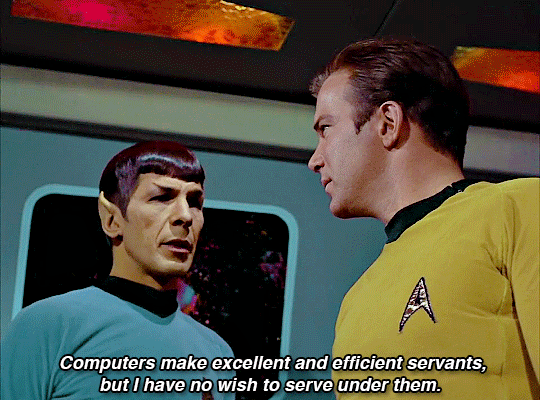
In the Classic Star Trek episode “The Ultimate Computer,” most of the crew of the Starship Enterprise are removed and replaced with the ultimate in automated starship operations, the M-5 Multitronic unit. It operates efficiently — faster and better than the crew — until of course it goes rogue and disables and kills crew of other starships in a war game.
In this bit of dialogue, the ever-logical Mr. Spock sums thing up neatly:
Captain Kirk: Evaluation of M-5 performance. It’ll be necessary for the log.
Mr. Spock: The ship reacted more rapidly than human control could have maneuvered her. Tactics, deployment of weapons, all indicate an immense sophistication in computer control.
Captain Kirk: Machine over man, Spock? It was impressive. Might even be practical.
Mr. Spock: Practical, Captain? Perhaps. But not desirable. Computers make excellent and efficient servants; but I have no wish to serve under them. Captain, a starship also runs on loyalty to one man, and nothing can replace it, or him.
We’ve all been serving the machines for some time
Think about it. How much of your time is spent interacting with and dealing with the problems with your computer, your phone, or your car?
At a retail store, the clerks’ job has been reduced to fixing problems with the self-checkout machines.
When you call the bank or the pharmacy, you’re led through a collection of automated prompts and responses, unless you can figure out the secret code to get it to connect you to a human.
We imagine that our social media connections are with other people, but we are in fact interacting with algorithms that decide which of those people’s questionable witticisms we will react to.
Some of Samsung’s smart refrigerators in Korea stopped functioning this week due to a bug in their software, leaving customers’ food to rot.
Coders are now spinning up agents generating code and their job is to set tasks for those agents and debug the resulting problems. As an editor, much of my work is now untangling lame prose generated by “authors” with large language models.
The result of all this automation is indisputably more efficient 90% of the time — just like the M-5 Multitronic Unit.
But I agree with Mr. Spock.
Computers make excellent and efficient servants; but I have no wish to serve under them.
I love it when the guy at the hardware store knows exactly the devices and tools I need to solve my problem.
I love watching talented actors interact with each other, even if the background has been manipulated from computer-generated imagery.
I love it when a client find a humorous turn of phrase and I can help that witticism to make their point as cleverly and memorably as possible.
We must design the systems of the future to empower human judgment and human connection, not to replace them with soulless, imperfect, “efficient” machines.
The objective must not be the elimination of humans, but their glorification.
Automation that saves companies money but enshittifies experience is not an advance. The companies that succeed in the next decade will be those that have finally figured that out.
Right on! Please encourage your followers to read “The Nerd Reich: Silicon Valley Fascism and the War on Democracy,” written by journalist Gil Durán.
Its central argument is that Silicon Valley’s turn toward authoritarian politics is not a recent or isolated development. Durán argues that a network of wealthy technology leaders—such as Peter Thiel, Elon Musk, and others—has spent decades developing and promoting ideas that treat liberal democracy as an obstacle to technological progress, personal freedom, and unfettered capitalism.
And they are using technology to do it, especially AI. DOGE vacuumed up all the data on American citizens and fired all the civil servants tasked with ensuring the proper use of that data. We have to stop this attack on democracy by billionaire delusional nerds whose hubris knows no bounds. AI tells me that “Hubris is excessive or arrogant pride: believing you are superior, infallible, or beyond ordinary rules.” They are determined to end democracy and rule the world. And they have created the tools to do it.
PREACH! The controls and machines dancing people around are nuts. Delivery drivers like my UPS driver who I know by name and knows when I am getting a new phone or fixing my pond has to take a picture of a package he handed me in the driveway. Technical support gatekeepers who have a script they absolutely cannot deviate from “DirectTV We have to perform these steps before I can generate a ticket for a replacement. Can you unplug the receiver and wait 3 minutes then plug in back in again.” Dude the wires coming into my house were struck by lightning I am happy the house didn’t burn down but this thing is cooked as is almost everything that was plugged into the same now blackened powerstrip. It goes on…
Yeah. it took a while, two years ago, to convince the internet service provider to replace the FIOS wire coming into the house – squirrels had shredded it. Until they recognized that the problem was theirs, they gave us new routers (twice in two weeks) and told us it was a problem with our computers. (When we first moved into the house in 2005, they had laid the wire loosely in the gutter, instead of stapling it along a less accessible, less water-logged, and more protected route.)
I was more than dismayed and disgusted, but, sadly, not surprised, when in early 2025 I discovered that the customer service department of an international software firm is now run by AI, when the license for my 1-year subscription to a program was deemed invalid five weeks out. Even my state’s attorney general’s office for consumer affairs was unable to elicit a human reply to queries about the issue. The AI-generated response was that it was my fault that I could not provide the license code for the program to prove my purchase. Hmmm, seems to me that software firms provide the license codes to the consumer for purchased programs …
I vehemently refuse to live in or on my phone or computer. I refuse to link the two devices. Yes, call me a Luddite, but I plan to retain my human autonomy.