LinkedIn will soon learn that AI slop is far easier to enable than to extinguish
This is the Gartner Hype Cycle. I have always admired the elegant way it explains how technology markets develop — and that’s high praise, given that I spent the heart of my career working for Gartner’s top competitor.

AI, like every other new technology, is subject to the hype cycle. From 2023 to 2025, it was rapidly ascending to the peak of inflated expectations. It’s currently suffering a backlash on its way to the trough of disillusionment.
LinkedIn is riding the rollercoaster to hell
Until recently, LinkedIn included features that made it easy for members to create content and comments using AI. Why? Certainly not because people were asking for it. The reason was that every tech company was adding AI features and that was the easiest feature that LinkedIn could create. It accelerated content creation at the cost of content quality.
The result, of course, was the rapid pollution of LinkedIn with undifferentiated vacuous commentary. AI is an excellent technology for creating bullshit at scale. You now needed neither minimal writing competence nor an actual idea to participate in the “dialogue.” (You need the scare quotes because “dialogue” normally refers to discourse between two people regarding ideas, not discussions in which there are neither actual people nor ideas.)
Now that we’re on the downslope of the hype cycle, LinkedIn has reversed itself. The AI-generated slop that it facilitated is no longer a convenience and has become a pervasive problem. LinkedIn has addressed this: you can now easily report a post as AI slop with a pull-down menu. (If you’re looking for it, just click on the “…” at the top right of any post. It’s not available for comments on posts yet, but they’ll probably add that soon.)
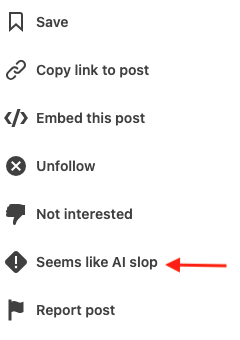
Using LinkedIn’s AI tools, any moron could create AI slop with only the slightest intellectual effort.
Now any moron can report AI slop without the slightest intellectual effort.
Since people can’t accurately identify slop, this is more likely to create chaos than to improve the LinkedIn environment.
AI is better at creating messes than cleaning them up
AI is good at summarizing, analyzing, and finding content.
It’s bad at writing. It’s also efficient.
Any technology that makes it easier to write without thinking decreases the value of that writing.
Any technological attempt to undo that problem will fail.
Brandolini’s Law states that “The amount of energy needed to refute bullshit is an order of magnitude bigger than that needed to produce it.”
The appropriate rewording for the AI era is this: “AI slop is an order of magnitude easier to create than it is to extinguish.”
Chasing the hype cycle up and down creates vertigo, not progress. LinkedIn is about to painfully learn that lesson, and it won’t be alone.
LinkedIn thinks it can put the proverbial toothpaste back in the tube, but it can’t – and it should have realized that *before* it squeezed the tube to start with!
The demise of the LinkedIn job search and networking tool provides a great opportunity for new competitors to it!